Puzzle at a Glance
|
|---|
Puzzle Number in The Daily Telegraph
DT 27917 | |
Publication Date in The Daily Telegraph
Saturday, September 26, 2015 | |
Setter
Unknown | |
Link to Full Review
Big Dave's Crossword Blog [DT 27917 – Hints]Big Dave's Crossword Blog [DT 27917 – Review] | |
Big Dave's Crossword Blog Review Written By
Big Dave (Hints)crypticsue (Review) | |
BD Rating
| |
| Difficulty - ★ | Enjoyment - ★★ |
Falcon's Experience
┌────┬────┬────┬────┬────┬────┬────┐
███████████████████████████████████
└────┴────┴────┴────┴────┴────┴────┘
Legend:
█ - solved without assistance
█ - incorrect prior to use of puzzle solving tools
█ - solved with assistance from puzzle solving tools
█ - solved with aid of checking letters provided by puzzle solving tools
█ - solved but without fully parsing the clue
█ - unsolved or incorrect prior to visiting Big Dave's Crossword Blog
█ - solved with aid of checking letters provided by solutions from Big Dave's Crossword Blog
█ - reviewed by Falcon for Big Dave's Crossword Blog
█ - yet to be solved
| |
Notes
| |
As this was a Saturday "Prize Puzzle" in Britain, there are two entries related to it on Big Dave's Crossword Blog — the first, posted on the date of publication, contains hints for selected clues while the second is a full review issued following the entry deadline for the contest. The vast majority of reader comments will generally be found attached to the "hints" posting with a minimal number — if any — accompanying the full review.
| |
Introduction
No, your eyes are not deceiving you. Crypticsue awarded this Saturday prize puzzle a mere one star for difficulty. However, as she says in her review, that is double the half star she had awarded to the Saturday puzzle the previous week (DT 27911 which appeared in the National Post this Wednesday past, February 17, 2016). I stand in awe!After writing the review, I can see why I found the puzzle to be more than one star difficulty. It has a fairly high content of Briticisms. While I was familiar with most of them, aside from the ancient BBC radio programme, I find that they tend to ooze to the surface over time rather than pop immediately to mind. This greatly extends the solving time.
I invite you to leave a comment to let us know how you fared with the puzzle.
Notes on Today's Puzzle
This commentary is intended to serve as a supplement to the review of this puzzle found at Big Dave's Crossword Blog, to which a link is provided in the table above.
Primary indications (definitions) are marked with a solid underline in the clue; subsidiary indications (be they wordplay or other) are marked with a dashed underline in all-in-one (&lit.) clues, semi-all-in-one (semi-&lit.) clues and cryptic definitions. Explicit link words and phrases are enclosed in forward slashes (/link/) and implicit links are shown as double forward slashes (//). Definitions presented in blue text are for terms that appear frequently.
Primary indications (definitions) are marked with a solid underline in the clue; subsidiary indications (be they wordplay or other) are marked with a dashed underline in all-in-one (&lit.) clues, semi-all-in-one (semi-&lit.) clues and cryptic definitions. Explicit link words and phrases are enclosed in forward slashes (/link/) and implicit links are shown as double forward slashes (//). Definitions presented in blue text are for terms that appear frequently.
Across
1a Pain from exercise /in/ saddle perhaps (6)
As a noun, saddle stitch[5] denotes:
- a stitch of thread or a wire staple passed through the fold of a magazine or booklet; or
- (in needlework) a decorative stitch made with long stitches on the upper side of the cloth alternated with short stitches on the underside.
a short-sleeved white shirt, saddle-stitched round the collar.
5a Detectives must probe old coin /in/ the West (8)
"detectives" = CID (show explanation )
The Criminal Investigation Department (seemingly better known by its abbreviation CID[2]) is the detective branch of a British police force.
hide explanation
The Criminal Investigation Department (seemingly better known by its abbreviation CID[2]) is the detective branch of a British police force.
hide explanation
In his hint, Big Dave refers to "a foreign coin" as the equivalent British coin is known as a penny. While the coin is not foreign in Canada, it has been extinct for four years.
9a Place of worship /gets/ a celebrant excited (10)
In the sense of a place of worship, tabernacle[10] may refer to:
- the Jewish Temple regarded as the shrine of the divine presence;
- a meeting place for worship used by Mormons or Nonconformists; or
- (mainly Roman Catholic Church) a canopied niche or recess forming the shrine of a statue.
10a Secures // trousers (4)
Bag[10] is an informal British term meaning to to reserve or secure the right to do or to have something ⇒
he bagged the best chair.
Bags[5] is a dated British term for loose-fitting trousers ⇒
a pair of flannel bags.
11a Someone lacking faith in one // violinist (8)
Niccolò Paganini[5] (1782–1840) was an Italian violinist and composer. His virtuoso violin recitals, including widespread use of pizzicato and harmonics, established him as a major figure of the romantic movement.
Pedant's Corner
| |
|---|---|
| A pagan[5] is not someone who lacks faith, but rather a person holding religious beliefs other than those of the main world religions. |
12a Goblin /has/ ill feeling about king (6)
"king" = R (show explanation )
Rex[5] (abbreviation R[5]) [Latin for king] denotes the reigning king, used following a name (e.g. Georgius Rex, King George) or in the titles of lawsuits (e.g. Rex v. Jones, the Crown versus Jones — often shortened to R. v. Jones).
hide explanation
Rex[5] (abbreviation R[5]) [Latin for king] denotes the reigning king, used following a name (e.g. Georgius Rex, King George) or in the titles of lawsuits (e.g. Rex v. Jones, the Crown versus Jones — often shortened to R. v. Jones).
hide explanation
13a American education // put into employment (4)
The abbreviation for education is ed.[2].
15a Drink humorously described /in/ a manuscript penned by a dramatic diarist (5,3)
In her explanation, crypticsue fails to account for one of the As. The wordplay is {A (from the clue) + MS (manuscript)} contained in (penned by) {A (from the clue) + DALE (diarist)}
I must admit that I bunged this one in — having never heard of the diarist.
Mrs Dale's Diary[7] was the first significant BBC radio serial drama. It was first broadcast in 1948 on the BBC Light Programme, which became Radio 2 in 1967; it ran until 1969. A new episode was broadcast each weekday afternoon, with a repeat the following morning.
Delving Deeper
| |
|---|---|
| An innovative characteristic of the programme was that a brief
introductory narrative in each episode was spoken by Mrs Dale as if she
were writing her diary. The serial centred on Mrs Mary Dale, a doctor's wife, husband Jim, and the comings and goings of a middle-class society. The lead character, Mrs Dale, was played by Ellis Powell until she was sacked in controversial circumstances in 1963 and replaced by Jessie Matthews. In 1975 Matthews' biographer, Michael Thornton, wrote: On 19 February 1963, a plump and embittered fifty-six-year-old character actress called Ellis Powell walked out of Broadcasting House for the last time. She was not a star. In fact she had earned less than £30 a week. But her voice was as well known in Britain as that of Queen Elizabeth II, for it was heard twice a day by seven million devoted listeners. Miss Powell was Britain's most sacrosanct fictional paragon, Mrs. Dale, in the radio serial Mrs. Dale's Diary. And now, after fifteen years in the role she had created, the BBC had summarily fired her partly because of her drinking habits, and partly because it was felt that the role, and also the entire programme, was in need of a facelift. Three months later, at the age of fifty-seven, she died. Her friends believed she never recovered from the shock and distress of her summary dismissal by the BBC. In the last weeks of her life she worked as a [product] demonstrator at the Ideal Home Exhibition and as a cleaner in an hotel.The programme is thought to be the first British mainstream drama which depicted sympathetically a character known to be homosexual in a leading part – Richard Fulton, the husband of Mary's sister Sally. It was a brave move to feature a gay man, especially when homosexuality was still illegal in the United Kingdom. The phrase seized on by caricaturists as typical of Mrs Dale's narrative was "I'm rather worried about Jim..." Indeed, the phrase was a staple of many comedy programmes, radio and television, in the early 1960s aiming to poke fun at safe, staid and undemanding middle-class lifestyles. The last episode ended with Mrs Dale saying, "There's one thing that won't change - I shall always worry about Jim..." |
What did he say?
| |
|---|---|
In Comment #1 to the review on Big Dave's Crossword Blog, gazza refers to Mrs Dale as being fromIn Britain, steam[2,10] is used as an adjective meaning old-fashioned in expressions such as steam radio, a term which seemingly came into use in the 1950s as television made its appearance. The idea behind the phrase is that radio would be obsoleted by television in the same way that steam engines were replaced by diesel locomotives. Today, apparently, some commentators in the U.K. refer in a similar manner to steam television which they see being superseded by programming broadcast over the Internet. For a more complete discussion, see the entry on steam radio at World Wide Words.the days of steam radio. Here, gazza uses the term "steam radio" to allude to the fact that the radio programme aired in the 1950s when this expression was in vogue. |
Adam's ale[5] is a dated, humorous term for water.
18a Animal is tangled /in/ yacht's propeller (8)
19a Pop group once providing their own backing (4)
Abba[5] is a Swedish pop group which became popular in the 1970s with catchy, well-crafted songs such as ‘Waterloo’ (1974) and ‘Knowing Me Knowing You’ (1977).
21a One harshly rules // what one can't do to a leopard? (6)
Contrary to crypticsue's assertion, I wouldn't say that you split the solution (2,4) — or even (2-4) as does Big Dave — to "find what you can’t do to a leopard". After all, words such as deice and demystify are not split (2, 3) and (2, 7) respectively.
23a Distinction /of/ modern artist from 'ere (8)
A bit of cockney in the clue means you must insert a corresponding bit of cockney in the solution.
Delving Deeper
| |
|---|---|
| A cockney[5] is a native of East London [specifically that part of East London known as the East End], traditionally one born within hearing of Bow Bells (the bells of St Mary-le-Bow[7] church). Cockney is also the name of the dialect or accent typical of cockneys, which is characterised by dropping the H from the beginning of words and the use of rhyming slang[5]. |
Tracey Emin[7] is an English artist and part of the group known as Britartists or YBAs (Young British Artists).
 Highlights of her work include Everyone I Have Ever Slept With 1963–1995 (shown in Big Dave's hints), a tent appliquéd with names, exhibited at the Royal Academy in London and My Bed (shown at right), an installation at the Tate Gallery consisting of
her own unmade dirty bed with used condoms and blood-stained underwear.
Highlights of her work include Everyone I Have Ever Slept With 1963–1995 (shown in Big Dave's hints), a tent appliquéd with names, exhibited at the Royal Academy in London and My Bed (shown at right), an installation at the Tate Gallery consisting of
her own unmade dirty bed with used condoms and blood-stained underwear.
25a Blue // feathers (4)
26a The last thing in the Bible // that could make cosy appeal (10)
The Apocalypse[5] is the complete final destruction of the world, as described in the biblical book of Revelation ⇒
the bell’s ringing is supposed to usher in the Apocalypse.
The Apocalypse[5] is also another name (especially in the Vulgate Bible [used by the Roman Catholic church]) for the book of Revelation.
The Apocalypse is "the last thing in the Bible" in two senses. The book of Revelation is the final book of the Bible[7] for most Christians, including those who follow the Catholic, Orthodox, and Protestant traditions. Moreover, the Apocalypse, being the Biblical prophecy of "the complete final destruction of the world", will be the "last thing" in mankind's earthly existence.
27a Box -- one acceptable /for/ horse (8)
As an adjective, on[5,10] is an informal, chiefly British term meaning tolerable, practicable, acceptable, etc. It would seem that the expression may most likely be encountered in the negative ⇒
your plan just isn't on.
28a Engine // stops going by elevated railway (6)
The El[5] is a US term for:
- an elevated railroad* (especially that in Chicago); or
- a train running on an elevated railroad*.
railwaywith the US
railroad.
Down
2d Portia rarely displays // luxurious headgear (5)
Scratching the Surface
| |
|---|---|
| Portia is a female given name, perhaps best known as that of the wife of Brutus in William Shakespeare's Julius Caesar. Porcia Catonis[7] (c.70 BC – 43 (or 42) BC), also known simply as Porcia, occasionally spelled "Portia" especially in 18th-century English literature, was a Roman woman who lived in the 1st century BC. She is best known for being the second wife of Marcus Junius Brutus, the most famous of Julius Caesar's assassins, and for her suicide, reputedly by swallowing hot coals. |
3d Trollope novel /in/ Churchill's retreat? (3,6)
Sir Winston Churchill[5] (1874–1965) was a British Conservative statesman, Prime Minister 1940-5 and 1951-5.
I think "the war den" is merely a generic description of a place to which Churchill might retreat during the war years. I could find no evidence of any specific place called The War Den.
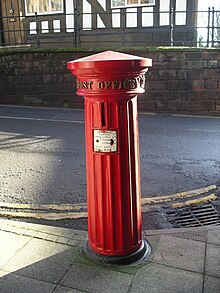
* A large red cylindrical public postbox [mailbox] used in the UK.
The Warden[7], published in 1855, is the first book in Anthony Trollope's Chronicles of Barsetshire series of six novels. It was his fourth novel.
4d Big actor falling short -- that is // what you need for a sad movie (6)
Big[7] is a 1988 American fantasy comedy film that stars Tom Hanks as Josh Baskin, a young boy who makes a wish "to be big" and is then aged to adulthood overnight.
5d What can make email bounce between two cricket sides // very rarely (4,2,1,4,4)
Here "two cricket sides" is actually two instances of the same side rather than two different sides.
In cricket, the on[5] (also known as on side) is another name for the leg[5] (also called leg side), the half of the field (as divided lengthways through the pitch) away from which the batsman’s feet are pointed when standing to receive the ball ⇒
he played a lucky stroke to leg. The other half of the field is known as the off[5] (also called off side).
Once in a blue moon[5] is an informal expression meaning very rarely ⇒
he comes round once in a blue moon. The expression derives from the fact that a ‘blue moon’ is a phenomenon that occurs only very rarely.
Delving Deeper
| |
|---|---|
| The term blue moon[5] came from the US where it was originally applied to the third full moon in a season which (exceptionally) contains four full moons (each season, as defined by the mean sun, normally containing three full moons). This now historical meaning is no longer used. In later use, the term came to mean a second full moon in a calendar month. |
6d Revolutionary Nazi guard -- // knight perhaps (8)
The SS[5] (abbreviation of German Schutzstaffel 'defence squadron') was the Nazi special police force. Founded in 1925 by Hitler as a personal bodyguard, the SS provided security forces (including the Gestapo) and administered the concentration camps.
7d Exclude // society girl meeting a queen (5)
"queen" = R (show explanation )
Regina[5] (abbreviation R[5]) [Latin for queen] denotes the reigning queen, used following a name (e.g. Elizabetha Regina, Queen Elizabeth) or in the titles of lawsuits (e.g. Regina v. Jones, the Crown versus Jones — often shortened to R. v. Jones).
Thus Queen Elizabeth signs her name as 'Elizabeth R' as seen here on Canada's paint-stained constitution.
 hide explanation
Regina[5] (abbreviation R[5]) [Latin for queen] denotes the reigning queen, used following a name (e.g. Elizabetha Regina, Queen Elizabeth) or in the titles of lawsuits (e.g. Regina v. Jones, the Crown versus Jones — often shortened to R. v. Jones).
Thus Queen Elizabeth signs her name as 'Elizabeth R' as seen here on Canada's paint-stained constitution.

8d Cook big lunch with last of brisket // joint for latecomers (9)
Scratching the Surface
| |
|---|---|
Joint[5] is a British [or perhaps not so British[3,11]] term for a large piece of meat cooked whole or ready for cooking ⇒ a joint of ham. |
14d Pot caused rogue to be this? (6,3)
The wordplay (indicated by the dashed underline) is embedded in the definition (the entire clue).
16d Corporation // to relieve Levantine city (5,4)
Levantine[5] is an adjective denoting relating to the Levant[5], an archaic name for the eastern part of the Mediterranean with its islands and neighbouring countries.
Tyre[5] is a port on the Mediterranean in southern Lebanon; population 41,800 (est. 2009). Founded in the 2nd millennium BC as a colony of Sidon, it was for centuries a Phoenician port and trading centre.
Tyre[5] is the British spelling of tire as an automobile part.
Corporation[3,4,5,11] is a dated humorous term for a large paunch or pot belly.
Rising Again
| |
|---|---|
| The term Levant comes from French, literally 'rising', present participle of lever 'to lift' used as a noun in the sense 'point of sunrise, east'. The term is experiencing a rebirth with the emergence of the terrorist group the Islamic State of Iraq and the Levant[7] (ISIL). Unfortunately, the CBC persists in referring to this group as ISIS (Islamic State of Iraq and Syria), a nomenclature that I personally abhor. The word Isis has many other uses which are besmirched by association with this terrorist group. Among them, Isis is the goddess of fertility in Egyptian mythology and has been incorporated into the name of many beauty parlours. Isis is also the name by which the River Thames is known as it flows through Oxford, England. |
17d Meat that's cooked // soft with butter in sparkling wine (8)
"soft" = P (show explanation )
Piano[3,5] (abbreviation p[5]), is a musical direction meaning either (as an adjective) soft or quiet or (as an adverb) softly or quietly.
hide explanation
Piano[3,5] (abbreviation p[5]), is a musical direction meaning either (as an adjective) soft or quiet or (as an adverb) softly or quietly.
hide explanation
"Butter" is a somewhat whimsical term for an animal that butts.
Asti[7] (formerly known as Asti Spumante) is a sparkling white Italian wine that is produced throughout southeastern Piedmont but is particularly focused around the towns of Asti and Alba. Since 1993 the wine has been classified as a Denominazione di Origine Controllata e Garantita (DOCG) and as of 2004 was Italy's largest producing appellation.
The definition "meat that's cooked" sent me off on a lengthy investigation to understand why its defined specifically as "cooked".
Pastrami[11] is a brisket* of beef cured in a mixture of seasonings and smoked before cooking.
* Most other dictionaries indicate that pastrami[1,2,3.4.10] is usually made from a shoulder cut.
Delving Deeper
| |
|---|---|
| The recipe for pastrami[7] as we know it today was developed in the latter half of the 19th century in New York by Jewish immigrants from Romania. To make pastrami, the raw meat is brined, partially dried, seasoned with herbs and spices, then smoked and steamed [i.e., "cooked"]. The word pastrami is not — as I had always supposed — of Italian origin. Rather the word comes from Yiddish pastrame which in turn derives from Romanian pastrama. The modified “pastrami” spelling was probably introduced in imitation of the American English salami (a word of Italian lineage). In the course of researching this entry, I discovered that cuts of meat vary greatly around the world. "Different countries and cuisines have different cuts and names, and sometimes use the same name for a different cut; e.g., the cut described as "brisket" in the US is from a significantly different part of the carcass than British brisket."[7] The American cultural anthropologist Margaret Mead wrote that "cultures that divide and cut beef specifically to consume are the Koreans and the Bodi tribe in East Africa. The French and English make 35 differentiations to the beef cuts, 51 cuts for the Bodi tribe, while the Koreans differentiate beef cuts into a staggering 120 different parts."[7] |
20d Tease a Liberal Democrat // with coarse humour (6)
Although there is a political party in the UK known as the Liberal Democrats (see box), I could find no evidence of the party name commonly being abbreviated as LD. Rather, the party name is typically shortened to Lib Dem[5] ⇒ (i)
the Lib Dems have promised a wholesale review of policy; (ii)
I’m voting Lib Dem. It is also unlikely that the clue is referring to the LDP[5] (Liberal Democratic Party), a Japanese political party.
I believe that this is a situation where we must "lift and separate" (a crossword term inspired by the old Playtex bra commercials). I see this "Liberal Democrat" as being an amalgam of two political parties — one from the UK and one from the US.
"Liberal" = L (show explanation )
The Liberal Party[5] (abbreviation Lib.[5] or L[2]) in Britain emerged in the 1860s from the old Whig Party and until the First World War was one of the two major parties in Britain. In 1988 the party regrouped with elements of the Social Democratic Party to form the Social and Liberal Democrats, now known as the Liberal Democrats. However, a small Liberal Party still exists.
Although Lib. may be the more common abbreviation for the Liberal Party in Britain—likely to distinguish it from the the Labour Party[5] (abbreviation Lab.[5])—Chambers 21st Century Dictionary indicates that L[2] may also be used.
hide explanation
The Liberal Party[5] (abbreviation Lib.[5] or L[2]) in Britain emerged in the 1860s from the old Whig Party and until the First World War was one of the two major parties in Britain. In 1988 the party regrouped with elements of the Social Democratic Party to form the Social and Liberal Democrats, now known as the Liberal Democrats. However, a small Liberal Party still exists.
Although Lib. may be the more common abbreviation for the Liberal Party in Britain—likely to distinguish it from the the Labour Party[5] (abbreviation Lab.[5])—Chambers 21st Century Dictionary indicates that L[2] may also be used.
hide explanation
A Democrat[5] (abbreviation D[5]) is a member of the Democratic Party[5], one of the two main US political parties (the other being the Republican Party), which follows a broadly liberal programme, tending to support social reform and minority rights.
Scratching the Surface
| |
|---|---|
| In the UK, the Liberal Democrats[5] are a political party (formerly the Social and Liberal Democrats) formed from the Liberal Party and members of the Social Democratic Party. |
22d Group of experts // criticise the Spanish (5)
"the Spanish" = EL (show explanation )
24d Station in India // left from historic building (5)
This "station" is one's standing in the social pecking order.
Caste[5] denotes each of the hereditary classes of Hindu society, distinguished by relative degrees of ritual purity or pollution and of social status ⇒ (i)
members of the lower castes; (ii)
a man of high caste.
Delving Deeper
| |
|---|---|
| There are four basic classes or varnas in Hindu society: Brahman (priest), Kshatriya (warrior), Vaisya (merchant or farmer), and Sudra (labourer). The lowest class, the scheduled caste (formerly known as untouchables), fall outside the varna system and have historically suffered extreme discrimination. |
Key to Reference Sources:Signing off for today — Falcon
[1] - The Chambers Dictionary, 11th Edition
[2] - Search Chambers - (Chambers 21st Century Dictionary)
[3] - TheFreeDictionary.com (American Heritage Dictionary)
[4] - TheFreeDictionary.com (Collins English Dictionary)
[5] - Oxford Dictionaries (Oxford Dictionary of English)
[6] - Oxford Dictionaries (Oxford American Dictionary)
[7] - Wikipedia
[8] - Reverso Online Dictionary (Collins French-English Dictionary)
[9] - Infoplease (Random House Unabridged Dictionary)
[10] - CollinsDictionary.com (Collins English Dictionary)
[11] - TheFreeDictionary.com (Random House Kernerman Webster's College Dictionary)


