Saturday, April 4, 2015

Saturday, April 4, 2015 — Cold and Wet


Introduction

I found the difficulty level of today's puzzle from Cox & Rathvon to be a cut above what we are accustomed to. I even resorted to calling in some electronic assistance on the final two clues — although, in hindsight, for no apparent reason.

I invite you to leave a comment to let us know how you fared with the puzzle.

Solution to Today's Puzzle

Falcon's Experience
┌────┬────┬────┬────┬────┬────┬────┐
███████████████████████████████████
└────┴────┴────┴────┴────┴────┴────┘
Legend:
- solved without assistance
- incorrect prior to use of puzzle solving tools
- solved with assistance from puzzle solving tools
- solved with aid of checking letters provided by puzzle solving tools
- solved but without fully parsing the clue
- yet to be solved

Legend: "*" anagram; "~" sounds like; "<" letters reversed

"( )" letters inserted; "_" letters deleted; "†" explicit in the clue

Primary indications (definitions) are marked with a solid underline in the clue; subsidiary indications (be they wordplay or other) are marked with a dashed underline in all-in-one (& lit.) clues, semi-all-in-one (semi-& lit.) clues and cryptic definitions. Explicit link words and phrases are enclosed in forward slashes (/link/) and implicit links are shown as double forward slashes (//).

Across

1a   Accumulated white stuff, // present and past, in bag (8)

S(NOW|P)ACK — {NOW (present) + P (past; a grammatical tense)} contained in (in) SACK (bag)

5a   Dad’s enclosing Mom’s front // areas of grass (6)

PA(M)PA|S — {PAPA (dad) + S ('s)} containing (enclosing) M (Mom's front [initial letter])

Pampas[5] (treated as singular or plural) are large treeless plains in South America ⇒ the southern pampas of Argentina.

9a   People who cut // loose ultimately among those who take part (8)

SH(E)ARERS — E (loosE ultimately [final letter]) contained in (among) SHARERS (those who take part [and leave the remainder for others])

10a   Range // roving is rare (6)

SIERRA — anagram (roving) of IS RARE

Especially in Spanish-speaking countries or the western US, sierra[5] is a term for a long jagged mountain chain.

11a   Indigo and green bathroom /in/ domed home (5)

I|G|LOO — I (indigo) + G (green) + LOO (bathroom)

The setters have used "indigo" to clue the letter I. I failed to find this usage in any of my regularly consulted dictionaries — nor does it appear in any of several other dictionaries.

Loo[5] is an informal British term for a toilet. However, I doubt that the Brits would ever refer to it as a bathroom.

Doing One's Business
In North America, somewhat bizarrely, a bathroom[5] is a room containing a toilet and washbasin which may or may not also contain a bathtub or shower. A room containing just a toilet and washbasin might be referred to as a half bath (generally when enumerating the total number of rooms in a dwelling, such as in a real estate listing ⇒ a split-level with two and a half baths).

In Britain, on the other hand, a bathroom[5] is a room containing a bathtub or shower which may or may not also contain a washbasin and a toilet.

Pity the poor North American visiting the UK who asks to use the bathroom and is handed a towel and a bar of soap and directed to a room without a toilet.

Other North American euphemisms for a toilet are washroom[5] and restroom[5]. The former may well be a term that is not used by Brits and the latter has quite a different meaning in the U.K. than it does in North America.

12a   Source of fruit // to relieve upset (5,4)

{OLIVE TREE}* — anagram (upset) of TO RELIEVE

14a   Bad management // evident in Flemish and linguistics (11)

_MISH|AND|LING_ — hidden in (evident in) FleMISH AND LINGuistics

Scratching the Surface
Flemish[5] denotes (1) the people of Flanders or (2) the Dutch language as spoken in Flanders. It is one of the two official languages of Belgium. Flanders is a region in the south-western part of the Low Countries, now divided between Belgium (where it forms the provinces of East and West Flanders), France, and the Netherlands. It was a powerful medieval principality and the scene of prolonged fighting during the First World War.

18a   Tenderly following scuba user // going off in different directions (11)

DIVER|GENTLY — GENTLY (tenderly) following (†) DIVER (scuba user)

21a   Stickily cover saint in // waterproof material (9)

TAR|PAUL|IN — TAR (stickily cover) + PAUL (saint) + IN (†)

St Paul[5] (died circa 64) was a missionary of Jewish descent; known as Paul the Apostle, or Saul of Tarsus, or the Apostle of the Gentiles. He first opposed the followers of Jesus, assisting at the martyrdom of St Stephen. On a mission to Damascus he was converted to Christianity after a vision and became one of the first major Christian missionaries and theologians. His epistles form part of the New Testament.

23a   Cold spell after opening // place underground (5)

_INTER — [W]INTER (cold spell) with the initial letter removed (after opening)

24a   Love dress with chic // source (6)

O|RIG|IN — O (love; nil score in tennis) + RIG (dress) + IN (chic)

Here I became fixated on the dress being a MINI and could not seen to make my mind go elsewhere.

25a   Being neat, // take a seat back outside feasts (8)

TI(DINES)S< — a reversal (back) of SIT (take a seat) containing (outside) DINES (feasts)

26a   Audibly alludes to // attractions (6)

SIGHTS~ — sounds like (audibly) CITES (alludes to)

I would tend to think that "to cite" is far more specific than "to allude to".

27a   Work with/ water // while lid is in view (8)

SE(AS|CAP)E — {AS (while) + CAP (lid)} contained in (in) SEE (view)

This work might be produced by an artist who sets up his easel on the shore.

I don't know why I had trouble with this one. I even had the contents of the container figured out but — rather ironically — I could not see the container.

Down

1d   Finch // is returning with rind (6)

SI<|SKIN — reversal (returning) of IS + SKIN (rind)

A siskin[5] is a small songbird related to the goldfinch, with yellow and black in the plumage. Species include the North Eurasian (spruce) siskin (Carduelis spinus), with dark-streaked greenish-yellow plumage, as well as several in the New World.

2d   A single bad // dramatist (6)

ONE|ILL — ONE (a single) + ILL (bad)

Eugene O'Neill[5] (1888–1953) was an American dramatist. He was awarded the Pulitzer Prize for his first full-length play, Beyond the Horizon (1920). Other notable works: The Iceman Cometh (1946) and Long Day’s Journey into Night (1956, posthumously).

3d   According to one-time // entertainer (9)

PER|FORMER — PER (according to) + FORMER (one-time)

4d   Eastern bloc processed // metal (6,5)

{CARBON STEEL}* — anagram (processed) of EASTERN BLOC

Scratching the Surface
Eastern bloc[5] denotes the countries of eastern and central Europe which were under Soviet domination from the end of the Second World War until the collapse of the Soviet communist system in 1989–91.

6d   Beer keeping four // spirited (5)

AL(IV)E — ALE (beer) containing (keeping) IV ([Roman numeral for] four)

7d   Description /of/ harbour rodent ingesting iodine (8)

PORT|RA(I)T — PORT (harbour) + {RAT (rodent) containing (ingesting) + I ([symbol representing the chemical element] iodine)}

8d   Wise about speed // of modern times (5-3)

S(PACE)-AGE — SAGE (wise) containing (about) PACE (speed)

The parsing shown above assumes that space-age is an adjective. Should one prefer space-age to be a noun, the parsing would be:
  • 8d   Wise about speed /of/ modern times (5-3)
13d   Oblivious, // occupying a true camper’s shelter I have (11)

IN|A|T|TENT|IVE — IN (occupying) + A (†) + T (true) + TENT (camper's shelter) + IVE ([contraction for] I have; I 've)

15d   Silly idea, rearranging // flowers (9)

DAYLILIES* — anagram (rearranging) of SILLY IDEA

A daylily[5] (or day lily) is any of various perennial plants of the genus Hemerocallis, native to Eurasia and widely cultivated for their large colorful flowers, which remain open for only one day.

16d   Straying into side // issues (8)

EDITIONS* — anagram (straying) of INTO SIDE

17d   Declaring // a victory sign wrong (8)

A|V|ERRING — A (†) + V (victory sign) + ERRING (wrong)

From the Vaults
From my review of DT 26677 (Decmber 27, 2011):

A V sign[7] made with the fingers and with the palm facing out may be a victory sign (as made famous by Sir Winston Churchill) or a peace sign (arising from the 1960s counterculture movement). However, in Australia, New Zealand, South Africa, Ireland, and the United Kingdom, when made with the palm facing in, it means "F**k off". [It seems that the Brits need two fingers to get across an idea that North Americans manage to convey with a single finger.]

For a time in the UK, "a Harvey (Smith)" became a way of describing the insulting version of the V sign, much as "the word of Cambronne" is used in France, or "the Trudeau salute" is used to describe the one-fingered salute in Canada. This happened because, in 1971, show-jumper Harvey Smith was disqualified for making a televised V sign to the judges after winning the British Show Jumping Derby at Hickstead. (His win was reinstated two days later.)

Harvey Smith pleaded that he was using a Victory sign, a defence also used by other figures in the public eye. Sometimes foreigners visiting the countries mentioned above use the "two-fingered salute" without knowing it is offensive to the natives, for example when ordering two beers in a noisy pub, or in the case of United States president George H. W. Bush, who, while touring Australia in 1992, attempted to give a "peace sign" to a group of farmers in Canberra—who were protesting about U.S. farm subsidies—and instead gave the insulting V sign.

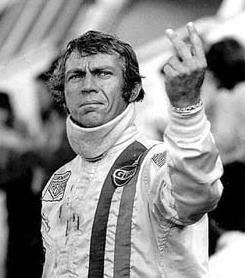
Steve McQueen in Le Mans
Steve McQueen gives a British (knuckles outward) V sign in the closing scene in the 1971 motorsport movie 'Le Mans'. A still picture of the gesture was also recorded by photographer Nigel Snowdon and has become an iconic image of both McQueen and the 24 hours of Le Mans.

19d   Two articles about next // goddess of Greece (6)

A|THEN|A — {A ([first] article) + A ([second] article)} containing (about) THEN (next)

In Greek mythology, Athena is another name for Athene[5], the patron goddess of Athens, typically allegorized into a personification of wisdom.

20d   Castaway // changed course (6)

CRUSOE — anagram (changed) of COURSE

Robinson Crusoe[5] is the hero of Daniel Defoe’s novel Robinson Crusoe (1719), who survives a shipwreck and lives for years on a desert island.

22d   Leaning // toward one lieutenant (5)

AT|I|LT — AT (toward; as in "pointing at") + I ([Roman numeral for] one) + LT ([abbreviation for] lieutenant)

Epilogue

The title of today's blog is inspired by 1a and 27a — and, perhaps, by the weather forecast.
Key to Reference Sources: 

[1]   - The Chambers Dictionary, 11th Edition
[2]   - Search Chambers - (Chambers 21st Century Dictionary)
[3]   - TheFreeDictionary.com (American Heritage Dictionary)
[4]   - TheFreeDictionary.com (Collins English Dictionary)
[5]   - Oxford Dictionaries (Oxford Dictionary of English)
[6]   - Oxford Dictionaries (Oxford American Dictionary)
[7]   - Wikipedia
[8]   - Reverso Online Dictionary (Collins French-English Dictionary)
[9]   - Infoplease (Random House Unabridged Dictionary)
[10] - CollinsDictionary.com (Collins English Dictionary)
[11] - TheFreeDictionary.com (Random House Kernerman Webster's College Dictionary)
Signing off for today — Falcon

Friday, April 3, 2015

Friday, April 3, 2015 — DT 27620 (Bonus Puzzle)


Prologue

It being Good Friday, there is no edition of the National Post today. Here is DT 27620, the puzzle that would have appeared had there been a paper.

The puzzle is rather on the gentler side, so it should not hold you back from whatever other activities you may have planned for today.

Enjoy the puzzle and have a Happy Easter.

As always, I invite you to leave a comment to let us know how you fared with the puzzle.

Puzzle at a Glance
Puzzle Number in The Daily Telegraph
DT 27620
Publication Date in The Daily Telegraph
Tuesday, October 14, 2014
Setter
Unknown
Link to Full Review
Big Dave's Crossword Blog [DT 27620]
Big Dave's Crossword Blog Review Written By
Gazza
BD Rating
Difficulty - ★★ Enjoyment - ★★
Falcon's Experience
┌────┬────┬────┬────┬────┬────┬────┐
███████████████████████████████████
└────┴────┴────┴────┴────┴────┴────┘
Legend:
- solved without assistance
- incorrect prior to use of puzzle solving tools
- solved with assistance from puzzle solving tools
- solved with aid of checking letters provided by puzzle solving tools
- solved but without fully parsing the clue
- unsolved or incorrect prior to visiting Big Dave's Crossword Blog
- solved with aid of checking letters provided by solutions from Big Dave's Crossword Blog
- reviewed by Falcon for Big Dave's Crossword Blog
- yet to be solved
Notes
I am expecting the National Post to skip this puzzle which was published in The Daily Telegraph on Tuesday, October 14, 2014.

Notes on Today's Puzzle

This commentary is intended to serve as a supplement to the review of this puzzle found at Big Dave's Crossword Blog, to which a link is provided in the table above.

Primary indications (definitions) are marked with a solid underline in the clue; subsidiary indications (be they wordplay or other) are marked with a dashed underline in all-in-one (&lit.) clues, semi-all-in-one (semi-&lit.) clues and cryptic definitions. Explicit link words and phrases are enclosed in forward slashes (/link/) and implicit links are shown as double forward slashes (//). Definitions presented in blue text are for terms that appear frequently.

Across

1a   Swell dance // skirt (8)

A puffball[5] (also puffball skirt[2]) is a short full skirt gathered around the hemline to produce a soft puffy shape ⇒ she chose a multicolour puffball creation for her wedding.

5a   Two articles about spymaster with // girl (6)

I had a slightly different explanation of the clue. However, I have adopted Gazza's interpretation which I believe is superior to mine.

As Gazza interprets the clue, the word "with" is part of the wordplay which parses as:
  • {A ([first] article) + A ([second] article)} containing (about) {M (spymaster) + AND (with)}
According to my original interpretation of the clue, the word "with" would have been a link word with the wordplay parsing as:
  • {A AND A} (two articles) containing (about) {M (spymaster)}
We sometimes see the word "with" used as a link word, in which case it may be used in the sense of characterized by or having ⇒ a person with intelligence and initiative[11] or it may be used to indicate the cause of a condition ⇒ he was trembling with fear[5]. Used in this latter sense, the word "with" essentially means "resulting from". However, in either of these cases, the clue would work better — or, perhaps, would work only — if the elements in the clue were inverted. That is, if the clue were phrased:
  • Girl with two articles about spymaster (6)
M[7] is a fictional character in Ian Fleming's James Bond books; the character is the Head of Secret Intelligence Service—also known as MI6.

Behind the Photo
Amanda Redman[7] is an English actress [of seemingly little renown outside the UK].

9a   Learning // game in publication (9)

Rugby union[10] (abbreviation RU[5]) is a form of rugby football played between teams of 15 players (in contrast to rugby league[5], which is played in teams of thirteen).

11a   I must enter remainder // to take exam again (5)

The surface reading of this clue seems rather odd — and I initially read it as "reminder" rather than "remainder".

Resit[5] is a British term which, as a verb, means to take (an examination) again after failing it  ⇒ she is resitting her maths GCSE [General Certificate of Secondary Education] and, as a noun, denotes an examination that is resat ⇒ the system allows the office to timetable all resits in a single block.

12a   Spinner, bowler, maybe /seen in/ film (3,3)

Bowler[5] (also bowler hat) is a chiefly British name for a man’s hard felt hat with a round dome-shaped crown. In North America, such a hat is known as a derby[5] — the name said to arise from American demand for a hat of the type worn at the Epsom Derby [an English horse racing event].

Top Hat[7] is a 1935 screwball musical comedy film in which Fred Astaire plays an American dancer named Jerry Travers, who comes to London to star in a show produced by Horace Hardwick (Edward Everett Horton). He meets and attempts to impress Dale Tremont (Ginger Rogers) to win her affection. The songs were written by Irving Berlin. "Top Hat, White Tie and Tails" and "Cheek to Cheek" have become American song classics. Top Hat — Astaire's second most successful picture after Easter Parade — was the most successful picture of Astaire and Rogers' partnership and remains, to this day, the partnership's best-known work.

Scratching the Surface
In the sport of cricket, bowling[7] is the action of propelling the ball toward the wicket defended by a batsman.

There are different types of bowlers ranging from fast bowlers, whose primary weapon is pace, through swing and seam bowlers who try to make the ball deviate in its course through the air or when it bounces, to slow bowlers, who will attempt to deceive the batsmen with a variety of flight and spin.

A spin bowler [or spinner] usually delivers the ball quite slowly and puts spin on the ball causing it to bounce at an angle off the pitch.

13a   Start // to play the part of Evita abroad (8)

It took me a while to sort out this clue. I initially thought that "start to play" must surely be clueing ACT I.

The wordplay parses as ACT (to play the part of) + an anagram (abroad) of EVITA.

Scratching the Surface
Evita[7] is a musical with music by Andrew Lloyd Webber and lyrics by Tim Rice. It concentrates on the life of Argentine political leader Eva Perón [known familiarly as Evita], the second wife of Argentine president Juan Perón. The story follows Evita's early life, rise to power, charity work, and eventual death.

15a   Showing off // magnificent still (13)

18a   Get nothing wrong? // Don't be deceived into thinking otherwise (4,2,7)

I have not marked this as a double definition, although Gazza has done so in his review. My rationale is that, while the solution does literally mean "get nothing wrong", I'm sure you won't find it defined thus in a dictionary.

22a   Protest about informer /being/ party member (8)

The party being a US political party.

Demo[5] is a chiefly British term for a public meeting or march protesting against something or expressing views on a political issue ⇒ a peace demo.

23a   Complete failure // hidden by Mafia's cover-up (6)

26a   Opening bars /of/ 8? Take it away (5)

The numeral "8" is a cross reference indicator directing the solver to insert the solution to clue 8d in its place to complete the clue. The directional indicator is customarily omitted in situations like this where only a single clue starts in square 8.

In 8d, anthem[5] is used in the sense of a national anthem, a solemn patriotic song officially adopted by a country as an expression of national identity.

However, in a cross reference, only the word is carried over — not necessarily the meaning. Thus, in the present clue, anthem[5] is used in the sense of a musical setting of a religious text to be sung by a choir during a church service, especially in Anglican or Protestant Churches.
In the Roman Catholic Church and the Church of England, an introit[10] is a short prayer said or sung as the celebrant is entering the sanctuary to celebrate Mass or Holy Communion.

27a   Total /made by/ county fair (9)

Down[5] is one of the Six Counties of Northern Ireland, since 1973 an administrative district; chief town, Downpatrick.

28a   List of charges /resulting from/ squabble when crossing a river (6)

29a   This, in wet areas, possibly (8)

Down

1d   Standing // pier gets demolished (8)

2d   Dowdy woman/'s/ fine bottom (5)

F[5] is an abbreviation for fine, as used in describing grades of pencil lead [a usage that Oxford Dictionaries Online surprisingly characterizes as British].

3d   Armed thief /in/ prison also (7)

4d   Den // left warm and dry (4)

6d   Swallow last of Chianti, // an Italian drink (7)

A martin[5] is any of numerous species of swift-flying insectivorous songbird of the swallow family, typically having a less strongly forked tail than a swallow.

Martini[5] (trademark) is a type of vermouth produced in Italy.

Scratching the Surface
Chianti[5] is a dry red Italian wine produced in Tuscany named after the Chianti Mountains, Italy.

7d   Sat in gaol, distraught, // longing for the past (9)

Scratching the Surface
Gaol[5] is an alternative British spelling of jail.

8d   Patriotic song /from/ worker on border (6)

10d   Old Harry, perhaps? (8)

Old Harry[10] is an informal jocular name for Satan.

Old Nick[10] is an informal jocular name for Satan.

14d   Flag/'s/ pattern (8)

16d   Mother in reform // school (4,5)

17d   One may get a story // about drink with the Queen (8)

The regnal ciphers (monograms) of British monarchs are initials formed from the Latin version of their first name followed by either Rex or Regina (Latin for king or queen, respectively). Thus, the regnal cipher of Queen Elizabeth is ER[5] — from the Latin Elizabetha Regina.

19d   Start // to stop out (4,3)

20d   Small child by bank /in/ squalid quarter (4,3)

21d   A meaning /that's/ lost (6)

24d   Wonder // most of the soldiers returned (5)

A GI[5] is a private soldier in the US army ⇒ she went off with a GI during the war. Contrary to popular belief, the term apparently is not an abbreviation for general infantryman, but rather derives from the term government (or general) issue (originally denoting equipment supplied to US forces).

25d   Detailed message, // precious (4)

The setter uses "detailed" in a whimsical cryptic crossword sense meaning having the tail removed — based on an analogy with words such as deflowered or defrocked.

A tweet[5] is a posting made on the social media website Twitter ⇒ he started posting tweets via his mobile phone to let his parents know he was safe.

Twee[5] is a British term meaning excessively or affectedly quaint, pretty, or sentimental ⇒ although the film’s a bit twee, it’s watchable.
Key to Reference Sources: 

[1]   - The Chambers Dictionary, 11th Edition
[2]   - Search Chambers - (Chambers 21st Century Dictionary)
[3]   - TheFreeDictionary.com (American Heritage Dictionary)
[4]   - TheFreeDictionary.com (Collins English Dictionary)
[5]   - Oxford Dictionaries (Oxford Dictionary of English)
[6]   - Oxford Dictionaries (Oxford American Dictionary)
[7]   - Wikipedia
[8]   - Reverso Online Dictionary (Collins French-English Dictionary)
[9]   - Infoplease (Random House Unabridged Dictionary)
[10] - CollinsDictionary.com (Collins English Dictionary)
[11] - TheFreeDictionary.com (Random House Kernerman Webster's College Dictionary)
Signing off for today — Falcon

Thursday, April 2, 2015

Thursday, April 2, 2015 — DT 27619


Puzzle at a Glance
Puzzle Number in The Daily Telegraph
DT 27619
Publication Date in The Daily Telegraph
Monday, October 13, 2014
Setter
Rufus (Roger Squires)
Link to Full Review
Big Dave's Crossword Blog [DT 27619]
Big Dave's Crossword Blog Review Written By
Big Dave
BD Rating
Difficulty - ★★ Enjoyment - ★★★★
Falcon's Experience
┌────┬────┬────┬────┬────┬────┬────┐
██████████████████████████████████
└────┴────┴────┴────┴────┴────┴────┘
Legend:
- solved without assistance
- incorrect prior to use of puzzle solving tools
- solved with assistance from puzzle solving tools
- solved with aid of checking letters provided by puzzle solving tools
- solved but without fully parsing the clue
- unsolved or incorrect prior to visiting Big Dave's Crossword Blog
- solved with aid of checking letters provided by solutions from Big Dave's Crossword Blog
- reviewed by Falcon for Big Dave's Crossword Blog
- yet to be solved

Introduction

As always from Rufus, a fun puzzle that is not overly taxing — although there are a couple of Briticisms that up the ante for those of us on this side of the pond.

Tomorrow being Good Friday, the National Post will not publish — but this blog will. Stop by for something to fill the void

I invite you to leave a comment to let us know how you fared with the puzzle.

Notes on Today's Puzzle

This commentary is intended to serve as a supplement to the review of this puzzle found at Big Dave's Crossword Blog, to which a link is provided in the table above.

Primary indications (definitions) are marked with a solid underline in the clue; subsidiary indications (be they wordplay or other) are marked with a dashed underline in all-in-one (&lit.) clues, semi-all-in-one (semi-&lit.) clues and cryptic definitions. Explicit link words and phrases are enclosed in forward slashes (/link/) and implicit links are shown as double forward slashes (//). Definitions presented in blue text are for terms that appear frequently.

Across

1a   Making a comeback just the same (11)

9a   When to make me smile at cook? (9)

I am afraid that I must take issue with Big Dave on the anagram indicator. Unless the word "cook" forms at least part of the anagram indicator, it serves no purpose. Therefore, I would parse the wordplay as an anagram (to make ... cook) of ME SMILE AT. Alternatively, I suppose one might consider the anagram indicator to be merely "cook".

10a   Servants /will give/ help in writing (5)

11a   Relaxation, // for example, about a moral slip (6)

12a   I'd backed secret reforms, /being/ detached (8)

13a   Car // presently has a learner inside (6)

The cryptic crossword convention of L meaning learner or student arises from the L-plate[7], a square plate bearing a sans-serif letter L, for learner, which must be affixed to the front and back of a vehicle in various countries (including the UK) if its driver is a learner under instruction.

Saloon[5] (also saloon car) is a British term for a car [known in Canada, the US, and New Zealand as a sedan[10]] having a closed body and a closed boot [trunk] separated from the part in which the driver and passengers sit ⇒ a four-door saloon.

15a   Cricket side and ground // not in harmony (3-5)

In cricket, the off[5]  (also called off side) is the half of the field (as divided lengthways through the pitch) towards which the batsman's feet are pointed when standing to receive the ball.  The other half of the field is known as either the leg[5] (also called leg side) or on[5] (also called on side)he played a lucky stroke to leg

Ground[5] denotes an area of land, often with associated buildings, used for a particular sport (i) a football ground; (ii) Liverpool’s new ground is nearing completion. While this is not an entirely British usage, the term is likely used there more often and applied to a wider range of sports facilities than would be the case in North America. For instance, I can't imagine a stadium in Canada being referred to as a 'ground'.
 In Britain, pitch[5] is another term for field[5] in the sense of an area of ground marked out or used for play in an outdoor team game ⇒ a football pitch.

In cricket, however, the pitch[5] is strictly the strip of ground between the two sets of stumps ⇒ both batsmen were stranded in the middle of the pitch.


18a   Skilfully holding back confusion /in/ meeting (8)

19a   In the morning will take exam, // not bothered whether it's right (6)

21a   Don't stand so close, // pets! (4,4)

The wordplay here is an inverse reversal. It is inverse in that the solution can be interpreted as wordplay which produces a result that occurs in the clue (which is the inverse of the normal situation where the wordplay in the clue produces a result in the solution). The solution is STEP BACK which can be interpreted as a reversal (back) of STEP to give the result PETS (found in the clue). The setter uses the exclamation mark to signal that something unusual is happening in the clue.

23a   Friend is back with pet -- // a pampered one (6)

26a   Stand /and/ refuse to go forward (5)

27a   Agreeing // to study issue with worker (9)

Con[5] is an archaic term meaning to study attentively or learn by heart (a piece of writing)  ⇒ the girls conned their pages with a great show of industry.

28a   Right // pocket (11)

Down

1d   Pets // publications coming out around the first of May (7)

Pet[5] is a [seemingly chiefly British] term meaning to treat (someone) with affection or favouritism; in other words, pamper ⇒ I was cosseted and petted and never shouted at.

2d   Hops, // skips /and/ jumps? (5)

This has to be numbered among the least cryptic clues that I have ever seen. I was certain that I must have overlooked something. But, it seems, I did not.

I presume that the cryptic aspect of the clue is a play on the expression "hop, skip, and jump"[5].

... or maybe not!
When I wrote the above, I was thinking of  the expression hop, skip, and jump[5] in the sense of an informal term for a short distance it’s just a hop, skip, and jump from my home town.

However, there may be a better explanation.
In a response to Comment #17 on Big Dave's blog, Rabbit Dave writes "It is a triple definition, and the surface reading is particularly Rufus-like in that “hop, skip and jump” is an alternative term (albeit I think not much used nowadays) for the athletics event the Triple Jump. A triple definition for a clue about Triple Jumps – very nice!".
Hop, skip, and jump[5] (or hop, step, and jump) is an old-fashioned term for triple jump[5], an athletic event in which competitors attempt to jump as far as possible by performing a hop, a step, and a jump from a running start.

3d   Out of nick, like a truant (3,2,4)

In ____ nick[5] is an informal British expression meaning in a specified condition ⇒ you’ve kept the car in good nick. Thus if someone is not in shape, the Brits might describe them as being ⇒ out of nick.

A Growing Collection
I can now add this meaning to a host of other meanings for nick — which certainly seems to be a very versatile word in the UK.
Nick[5] is an informal British name for a prison ⇒ he’ll end up in the nick for the rest of his life.

Nick[5] is an informal British name for a police station ⇒ he was being fingerprinted in the nick.

Nick[5] is an informal British term meaning to arrest (someone) ⇒ Stuart and Dan got nicked for burglary.

Nick[5] is an informal British term meaning to steal ⇒ she nicked fivers from the till.

In Britain, a form[5] is a class or year in a school, usually given a specifying number. Thus the fifth form would be the British linguistic counterpart (although not the academic equivalent) of the fifth grade in North America and Form One would be akin to saying Grade One.

Delving Deeper
A form[7] is normally identified by a number such as "first form" or "sixth form". A form number may be used for two year groups and differentiated by the terms upper and lower. The sixth form is the senior form of a school, and is usually divided into two year groups: the lower sixth and upper sixth. If there is more than one form for each year group they will normally be differentiated by letters, e.g., "upper four B", "lower two Y". Schools do not follow a consistent pattern in naming forms.

4d   City of three million, // possibly more (4)

Rome[5] is the capital of Italy and of the Lazio region, situated on the River Tiber about 25 km (16 miles) inland; population 2,724,347 (2008) [In his review, Big Dave gives a 2010 population figure from Wikipedia. Subsequent to that posting, Wikipedia has updated its entry and currently shows Rome having a population of 2,869,461 (2014)[7]].

5d   Mother's pets? // Dogs (8)

6d   Publication /for/ an entertainer? (5)

7d   Beg /for/ quarter in the wood (7)

This was my last one in as I got lost in a stand of ash until I eventually stumbled upon a beech.

8d   His coaching ability is brought into play (8)

14d   Star embraced by girl // entertainment centre (3,5)

Vega[5] is the fifth-brightest star in the sky, and the brightest in the constellation Lyra, overhead in summer to observers in the northern hemisphere.

16d   Splendour pursued by a grim // French mistress (9)

The Marquise de Pompadour[5] (1721–64) was a French noblewoman; known as Madame de Pompadour; born Jeanne Antoinette Poisson. In 1744 she became the mistress of Louis XV, gaining considerable influence at court, but she later became unpopular as a result of her interference in political affairs.

17d   Bird of ill omen to old criminal? (8)

The blackcap[5] is a mainly European warbler (Sylvia atricapilla) with a black cap in the male and a reddish-brown one in the female.

In English law, the black cap[7] was worn by a judge when passing a sentence of death. Although it is called a "cap", it is not made to fit the head like a typical cap does; instead it is a simple plain square made of black fabric. It was based on Tudor Court headgear. When worn, it is placed on the head on top of the judicial wig, with one of the four corners of the black fabric facing outward.

The death penalty has now been abolished in England and Wales, but the black cap is still part of a judge's official regalia, and as such it is still carried into the High Court by each sitting judge when full ceremonial dress is called for. It is worn every year on 9 November when the new Lord Mayor of the City of London is presented to the Law Courts.

18d   After getting behind in the US, doctor sits /and/ helps (7)

This clue brought a chuckle. Rufus cheekily uses "behind in the US" to clue ASS. The term used in the UK for this part of the anatomy is arse.

20d   He gets what's left -- // it's consumed in wild glee (7)

22d   Brought up a block /of/ wood (5)

24d   Play // maiden in RADA cast (5)

In cricket, a maiden[5], also known as a maiden over, (abbreviation M)[5] is an over in which no runs are scored. An over[5] is a division of play consisting of a sequence of six balls bowled by a bowler from one end of the pitch, after which another bowler takes over from the other end.

Scratching the Surface
The Royal Academy of Dramatic Art[7] (abbreviation RADA) is a drama school located in London, England. It is one of the oldest drama schools in the United Kingdom, founded in 1904.

25d   News cut short (4)
Key to Reference Sources: 

[1]   - The Chambers Dictionary, 11th Edition
[2]   - Search Chambers - (Chambers 21st Century Dictionary)
[3]   - TheFreeDictionary.com (American Heritage Dictionary)
[4]   - TheFreeDictionary.com (Collins English Dictionary)
[5]   - Oxford Dictionaries (Oxford Dictionary of English)
[6]   - Oxford Dictionaries (Oxford American Dictionary)
[7]   - Wikipedia
[8]   - Reverso Online Dictionary (Collins French-English Dictionary)
[9]   - Infoplease (Random House Unabridged Dictionary)
[10] - CollinsDictionary.com (Collins English Dictionary)
[11] - TheFreeDictionary.com (Random House Kernerman Webster's College Dictionary)
Signing off for today — Falcon

Wednesday, April 1, 2015

Wednesday, April 1, 2015 — DT 27618


Puzzle at a Glance
Puzzle Number in The Daily Telegraph
DT 27618
Publication Date in The Daily Telegraph
Saturday, October 11, 2014
Setter
Unknown
Link to Full Review
Big Dave's Crossword Blog [DT 27618 – Hints]
Big Dave's Crossword Blog [DT 27618 – Review]
Big Dave's Crossword Blog Review Written By
Big Dave (Hints)
gnomethang (Review)
BD Rating
Difficulty - Enjoyment - ★★★
Falcon's Experience
┌────┬────┬────┬────┬────┬────┬────┐
██████████████████████████████████
└────┴────┴────┴────┴────┴────┴────┘
Legend:
- solved without assistance
- incorrect prior to use of puzzle solving tools
- solved with assistance from puzzle solving tools
- solved with aid of checking letters provided by puzzle solving tools
- solved but without fully parsing the clue
- unsolved or incorrect prior to visiting Big Dave's Crossword Blog
- solved with aid of checking letters provided by solutions from Big Dave's Crossword Blog
- reviewed by Falcon for Big Dave's Crossword Blog
- yet to be solved
Notes
As this was a Saturday "Prize Puzzle" in Britain, there are two entries related to it on Big Dave's Crossword Blog — the first, posted on the date of publication, contains hints for selected clues while the second is a full review issued following the entry deadline for the contest. The vast majority of reader comments will generally be found attached to the "hints" posting with a minimal number — if any — accompanying the full review.

Introduction

For no discernible reason, I became hung up on 16a. This was rather disconcerting given that gnomethang rated the puzzle as merely a single star for difficulty.

I invite you to leave a comment to let us know how you fared with the puzzle.

Notes on Today's Puzzle

This commentary is intended to serve as a supplement to the review of this puzzle found at Big Dave's Crossword Blog, to which a link is provided in the table above.

Primary indications (definitions) are marked with a solid underline in the clue; subsidiary indications (be they wordplay or other) are marked with a dashed underline in all-in-one (&lit.) clues, semi-all-in-one (semi-&lit.) clues and cryptic definitions. Explicit link words and phrases are enclosed in forward slashes (/link/) and implicit links are shown as double forward slashes (//). Definitions presented in blue text are for terms that appear frequently.

Across

1a   Curt comedian abandoned // without popular support (12)

As an anagram indicator, abandoned[10] is used as an adjective meaning unrestrained or uninhibited ⇒ wild, abandoned dancing.

9a   Woman who's left // Nazi without resentment (7)

Rudolf Hess[5] (1894–1987) was a German Nazi politician, deputy leader of the Nazi Party 1934–41. In 1941, secretly and on his own initiative, he parachuted into Scotland to negotiate peace with Britain. He was imprisoned for the duration of the war and, at the Nuremberg war trials, sentenced to life imprisonment in Spandau prison, Berlin, where he died.

10a   Fashionable costumier, // poet is dressed by me (7)

Modiste[5] is a dated term for a fashionable milliner or dressmaker.

11a   Support protecting single // innovator (7)

12a   Had too much of // composer in regressive act (7)

Giuseppe Verdi[5] (1813–1901) was an Italian composer. His many operas, such as La Traviata (1853), Aida (1871), and Otello (1887), emphasize the dramatic element, treating personal stories on a heroic scale and often against backgrounds that reflect his political interests. Verdi is also famous for his Requiem (1874).

13a   Surrealist /shows/ seabirds with head on wrong end (5)

Max Ernst[5] (1891–1976) was a German artist. He was a leader of the Dada movement and developed the techniques of collage, photomontage, and frottage. He is probably best known for surrealist paintings such as L’Eléphant de Célèbes (1921).

14a   Most insist on tucking into French cheese -- here? (9)

As gnomethang points out in his review, this is a semi all-in-one clue — although you wouldn't be able to tell that from the way he has marked the clue.

The entire clue is a definition of an establishment where one could indulge in some French cheese.

A brasserie[5] is a restaurant in France or in a French style.

16a   Ban // girl coming out with topless dress (9)

I suffered a total mental block here. I saw the wordplay; I recognized the girl; but, for the life of me, I could not come up with the dress. However, only a very gentle nudge from my electronic assistants was needed to reveal everything.

19a   Graduate turned equipment /to make/ dyed cloth (5)

21a   Old man does up // grand buildings (7)

23a   Saddle // hurtful with one aboard little horse endlessly (7)

24a   Tailor lent tie /to give/ style (7)

Style[5] is used in the sense of to designate with a particular name, description, or title ⇒ the official is styled principal and vice chancellor of the university.

25a   Boy keeps tumbling down // mountain (7)

Snowdon[5] is a mountain in northwestern Wales. Rising to 1,085 m (3,560 ft), it is the highest mountain in Wales.

26a   Bribe with £500 // someone to fix things (6,6)

Monkey[5] is an informal British term for a sum of £500.

Down

1d   Northern Ireland company aboard vessel /finding/ mythical beast (7)

2d   Least shallow // river -- nuisance going under (7)

The Dee[5] is a river in northeastern Scotland, which rises in the Grampian Mountains and flows eastwards past Balmoral Castle to the North Sea at Aberdeen. Another river of the same name rises in North Wales and flows past Chester and on into the Irish Sea.

3d   Skinflint fit /to be/ unhappy (9)

4d   Appeared ordinary /in/ small role (5)

In the UK (with the exception of Scotland), O level[5] (ordinary level)[5] is a qualification in a specific subject formerly taken by school students aged 14-16, at a level below A level. It was replaced in 1988 by the  GCSE[5] (General Certificate of Secondary Education).

5d   Mini maybe parked by a daughter/'s/ home (7)

Scratching the Surface
In the surface reading,  Mini[7] is an automobile brand, currently owned by BMW, but originally introduced as a model under the Austin and Morris marques by the British Motor Corporation (BMC).

6d   One shoddily rinsed // one's privy (7)

Scratching the Surface
In the surface reading, privy[5] is used in the sense of a toilet located in a small shed outside a house or other building. 

7d   MI5 after tender // meat dishes (9,4)

The Security Service, commonly known as MI5[5] (Military Intelligence, Section 5), is the United Kingdom's domestic counter-intelligence and security agency and is part of its intelligence machinery alongside the Secret Intelligence Service (SIS; also known as MI6) focused on foreign threats, Government Communications Headquarters (GCHQ) and Defence Intelligence (DI).

8d   Locating ship's position // accounting for fatalities? (4-9)

15d   What could be turned into tapas? (9)

Although gnomethang identifies this clue as an &lit. (all-in-one), I don't believe that to be the case. Instead, I think it is a semi-&lit. (semi-all-in-one). The entire clue does serve as the definition, but only part of the clue (that portion having the dashed underlining) provides the wordplay which is an anagram (turned) of INTO TAPAS.

Tapas[2] are light savoury snacks or appetizers, especially those based on Spanish foods and cooking techniques and served with drinks. Oxford Dictionaries Online explains the etymology as Spanish tapa, literally 'cover, lid' (because the dishes were given free with the drink, served on a dish balanced on, therefore ‘covering’, the glass).[5]

In Italian cookery, antipasto[5] (plural antipasti) denotes an hors d'oeuvre.

17d   Horse that runs away, perhaps, carrying son/'s/ padded support (7)

18d   Sample of apricot tart /and/ soft cheese (7)

Ricotta[2] is a soft white unsalted Italian curd cheese made from sheep's or cow's milk and often used in sauces for ravioli, lasagne, etc.

19d   Steer // three characters from Istanbul to join Yale, say (7)

Yale[7] is an American lock manufacturer owned by Swedish lock manufacturer Assa Abloy. The business was founded as the Yale Lock Manufacturing Co. in Stamford, Connecticut in 1868 by Linus Yale, Jr., the inventor of the pin tumbler lock (sic), and Henry R. Towne.

Delving Deeper
Yale established a British operation by acquiring the business of H&T Vaughan, a long-established lock manufacturer in Wood Street, Willenhall, the historic centre of the British lock industry, and became the major employer in the town. "Yale locks" became the generic term in the UK for pin-tumbler household locks and keys.

Unlocking the Truth
If Linus Yale, Jr. did indeed invent the pin tumbler lock then he must have done it in a previous incarnation. Basic principles of the pin tumbler lock[7] may date as far back as 4000 BC in Egypt.

Behind the Name
Only yesterday, I saw a truck with the name Assa Abloy on it and wondered what sort of business it might be in. What a strange coincidence to run across it again.

The Assa Abloy Group was formed when Swedish lock manufacturer Assa AB acquired Finnish lock manufacturer Abloy Oy (AB means Ltd. in Swedish and Oy means Ltd. in Finnish).

The name Assa comes from August Stenman Stenman August (I would guess that August Stenman was the name of the company founder). The name Abloy comes from  AB Låsfabriken/Lukkotehdas Oy which breaks down as AB (Ltd. in Swedish) + L (for Låsfabriken [lock factory in Swedish] and Lukkotehdas [lock factory in Finnish]) + Oy (Ltd. in Finnish).

And, no, this is not an April Fool's joke.

20d   Half of them drily cooked, // as French hens appear at Christmas? (7)

In the English Christmas carol "The Twelve Days of Christmas"[7], three French hens are first presented on the third day of Christmas.

22d   Kid // persuaded by speech (5)

Kid[3] is leather made from the skin of a young goat; kidskin.

Suede[11] is kid or other leather finished with a soft, napped surface.
Key to Reference Sources: 

[1]   - The Chambers Dictionary, 11th Edition
[2]   - Search Chambers - (Chambers 21st Century Dictionary)
[3]   - TheFreeDictionary.com (American Heritage Dictionary)
[4]   - TheFreeDictionary.com (Collins English Dictionary)
[5]   - Oxford Dictionaries (Oxford Dictionary of English)
[6]   - Oxford Dictionaries (Oxford American Dictionary)
[7]   - Wikipedia
[8]   - Reverso Online Dictionary (Collins French-English Dictionary)
[9]   - Infoplease (Random House Unabridged Dictionary)
[10] - CollinsDictionary.com (Collins English Dictionary)
[11] - TheFreeDictionary.com (Random House Kernerman Webster's College Dictionary)
Signing off for today — Falcon