Tuesday, December 26, 2017

Tuesday, December 26, 2017 — DT 28536

Puzzle at a Glance
Puzzle Number in The Daily Telegraph
DT 28536
Publication Date in The Daily Telegraph
Tuesday, September 19, 2017
Setter
Mister Ron (Chris Lancaster)
Link to Full Review
Big Dave's Crossword Blog [DT 28536]
Big Dave's Crossword Blog Review Written By
Mr Kitty
BD Rating
Difficulty - ★★ Enjoyment - ★★ / ★★★
Falcon's Experience
┌────┬────┬────┬────┬────┬────┬────┐
███████████████████████████████████
└────┴────┴────┴────┴────┴────┴────┘
Legend:
█ - solved without assistance
█ - incorrect prior to use of puzzle solving tools
█ - solved with assistance from puzzle solving tools
█ - solved with aid of checking letters provided by puzzle solving tools
█ - solved but without fully parsing the clue
█ - unsolved or incorrect prior to visiting Big Dave's Crossword Blog
█ - solved with aid of checking letters provided by solutions from Big Dave's Crossword Blog
█ - reviewed by Falcon for Big Dave's Crossword Blog
█ - yet to be solved

Introduction

If your mental processes are still recovering from a surfeit of turkey, you will appreciated the gentle workout delivered in today's puzzle from Mister Ron.

I invite you to leave a comment to let us know how you fared with the puzzle.

Notes on Today's Puzzle

This commentary is intended to serve as a supplement to the review of this puzzle found at Big Dave's Crossword Blog, to which a link is provided in the table above.

Primary indications (definitions) are marked with a solid underline in the clue; subsidiary indications (be they wordplay or other) are marked with a dashed underline in semi-all-in-one (semi-&lit.) clues. All-in-one (&lit.) clues and cryptic definitions are marked with a dotted underline. Explicit link words and phrases are enclosed in forward slashes (/link/) and implicit links are shown as double forward slashes (//).

Across

1a   Accept // what chess player might do (4,2,5)

Take (something) on board[5] is an informal expression meaning to fully consider or assimilate a new idea or situation ⇒ we've got to take accusations of sexism on board.

9a   Continue // exercise with runs getting tough (9)

"exercise" = PE (show explanation )

PE[5] is the abbreviation for physical education [or Phys Ed, as it was known in my school days]. 

hide explanation

"runs" = R (show explanation )

On cricket scorecards [not to mention baseball scoreboards], the abbreviation R[5] denotes run(s).

In cricket, a run[5] is a unit of scoring achieved by hitting the ball so that both batsmen are able to run between the wickets, or awarded in some other circumstances.

hide explanation

10a   Tea in // group of hotels? (5)

Cha (also chai) is an alternative spelling of char[5], an informal British name for tea [as a drink].

11a   Boring // article in French by Dane, possibly (6)

"article in French" = LE (show explanation )

In French, the masculine singular form of the definite article is le[8].

hide explanation

12a   One holy with rage holds king /to be/ outsider (8)

"king" = R (show explanation )

In the United Kingdom and the other Commonwealth realms*, Rex[5] (abbreviation R[5]) [Latin for king] denotes the reigning king, used following a name (e.g. Georgius Rex, King George — often shortened to GR) or in the titles of lawsuits (e.g. Rex v. Jones, the Crown versus Jones — often shortened to R. v. Jones).

* A Commonwealth realm[7] is a sovereign state that is a member of the Commonwealth of Nations and shares the same person, currently Elizabeth II, as its head of state and reigning constitutional monarch, but retains a crown legally distinct from the other realms. There are currently sixteen Commonwealth realms, the largest being Australia, Canada, New Zealand, and the United Kingdom with the remainder being smaller Caribbean and Pacific island nations.

hide explanation

13a   Fawn /is/ more natural when passing over fifty (6)

As a deletion indicator, pass over[10] is used in the sense of to take no notice of or to disregard.

15a   Self-determination, // a service offered by generous solicitors? (4,4)

18a   Tot at lights out /in/ old-fashioned bed wear (8)

19a   Exploited // sailor took drugs (6)

"sailor" = AB (show explanation )

In the Royal Navy, according to Oxford Dictionaries, able seaman[5] (abbreviation AB[5]), is a rank of sailor above ordinary seaman and below leading seaman. On the other hand, Collins English Dictionary tells us that an able seaman[10] (also called able-bodied seaman) is an ordinary seaman, especially one in the merchant navy, who has been trained in certain skills.

hide explanation

21a   Cocktail // dance, led by son today (8)

A snowball[5] is a cocktail containing advocaat* and lemonade.

* Advocaat[5] is a liqueur made with eggs, sugar, and brandy.

23a   Fear mad admiral is impeding // fleet (6)

26a   Wet /and/ bright? Not at first (5)

27a   Company abandons helpful // worker (9)

28a   On dress, perfume /is/ evocative (11)

Down

1d   Clue: regularly pilfer small // drinks (7)

"Regularly" indicates that we are to select a regular sequence of letters from the fodder. In most cases, this will be every other letter — although, as today, the setter often does not specify whether it be the evens or the odds. On rare occasions, I have seen setters use this device to denote every third letter.

2d   Fate // that's more peaceful, reportedly (5)

Oh, dear. It is bad enough when a homophone involves one non-rhotic pronunciation but today both words require a non-rhotic pronunciation.

The words "CALMER" () and "KARMA" (), when pronounced in a non-rhotic (show explanation ) accent typical of dialects found in many parts of Britain, both sound like "KA-MAH".

Non-rhotic accents omit the sound < r > in certain situations, while rhotic accents generally pronounce < r > in all contexts. Among the several dozen British English accents which exist, many are non-rhotic while American English (US and Canadian) is mainly rhotic. This is, however, a generalisation, as there are areas of Britain that are rhotic, and areas of America that are non-rhotic. For more information, see this guide to pronouncing < r > in British English.

hide explanation

In Hinduism and Buddhism, karma[5] (from the Sanskrit word for 'fate') is the sum of a person’s actions in this and previous states of existence, viewed as deciding their fate in future existences. Informally, the term has come to mean good or bad luck, viewed as resulting from one’s actions.

3d   Work too hard // crossing river, right? (9)

The River Exe[7] rises on Exmoor in Somerset, 8.4 kilometres (5 mi) from the Bristol Channel coast, but flows more or less directly due south, so that most of its length lies in Devon. It reaches the sea at a substantial ria, the Exe Estuary, on the south (English Channel) coast of Devon.

4d   One that buzzes around picking stuff up following // complaint (4)

In publishing, the abbreviation f.[10] (plural ff.) is used to denote following (page).

5d   Opening/'s/ curiously premature, losing millions (8)

6d   House // in Russia, definitely with a supporting church (5)

"in Russia, definitely" = DA (show explanation )

In Cyrillic, the Russian word for yes[8] is да which transliterates into English[7] as da.

hide explanation

A dacha[5] (also datcha) is a country house or cottage in Russia, typically used as a second or holiday home.

7d   Most important, // as she is to Bolshevik? (7)

Scratching the Surface
Historically, a Bolshevik[5] was a member of the majority faction of the Russian Social Democratic Party, which seized power in the October Revolution of 1917.

Today, the term is derogatorily applied to a person with politically subversive or radical views; in other words, a revolutionary.

8d   Pub profits -- selling these? (8)

This clue proved to be a nightmare to markup in any sort of meaningful way. While the pronoun "these" actually represents the solution in the clue, I maintain that a pronoun in its own right can rarely — if ever — stand alone as a definition. Therefore, I consider the entire clue to be a cryptic definition. However, there is also wordplay (in the form of a charade) embedded within the clue. If not for the presence of the wordplay, I would have marked the entire clue with a dotted underline to signify a cryptic definition. However, the wordplay gets a dashed underline. The absence of separators (//) shows that this is an all-in-one style clue.

14d   Colour /making/ animal go mad (8)

Magnolia[5] is a pale creamy-white colour like that of magnolia blossom ⇒ the woodwork is in magnolia gloss.

16d   Doctor bears arms -- // shame! (9)

17d   Start to make trouble over space /in/ sorting office (8)

18d   Last of bitumen or silt damaged // air-intake (7)

20d   Citadel deployed // specific form of language (7)

22d   Queen succeeds by keeping posh /and/ one's stocking up (5)

"Queen" = ER, the regnal cipher of Queen Elizabeth (show explanation )

The regnal ciphers (monograms) of British monarchs are initials formed from the Latin version of their first name followed by either Rex or Regina (Latin for king or queen, respectively). Thus, the regnal cipher of Queen Elizabeth is ER[5] — from the Latin Elizabetha Regina.

hide explanation

"posh" = U (show explanation )

In Britain, U[5] is used informally as an adjective (in respect to language or social behaviour) meaning characteristic of or appropriate to the upper social classes ⇒ U manners.

The term, an abbreviation of  upper class, was coined in 1954 by Alan S. C. Ross, professor of linguistics, and popularized by its use in Nancy Mitford's Noblesse Oblige (1956).

In Crosswordland, the letter U is frequently clued by words denoting "characteristic of the upper class" (such as posh or superior) or "appropriate to the upper class" (such as acceptable). 

hide explanation

24d   Put up with // papers penned by president (5)

Abraham Lincoln[5] (1809–1865) was an American Republican statesman, 16th President of the US 1861-5. He was affectionately known as "Honest Abe"[7]. His election as President on an anti-slavery platform helped precipitate the American Civil War; he was assassinated shortly after the war ended. Lincoln was noted for his succinct, eloquent speeches, including the Gettysburg Address of 1863.

25d   Cut // when working (4)
Key to Reference Sources: 

[1]   - The Chambers Dictionary, 11th Edition
[2]   - Search Chambers - (Chambers 21st Century Dictionary)
[3]   - TheFreeDictionary.com (American Heritage Dictionary)
[4]   - TheFreeDictionary.com (Collins English Dictionary)
[5]   - Oxford Dictionaries (Oxford Dictionary of English)
[6]   - Oxford Dictionaries (Oxford American Dictionary)
[7]   - Wikipedia
[8]   - Reverso Online Dictionary (Collins French-English Dictionary)
[9]   - Infoplease (Random House Unabridged Dictionary)
[10] - CollinsDictionary.com (Collins English Dictionary)
[11] - TheFreeDictionary.com (Random House Kernerman Webster's College Dictionary)
[12] - CollinsDictionary.com (Webster’s New World College Dictionary)
[13] - MacmillanDictionary.com (Macmillan Dictionary)
Signing off for today — Falcon

Sunday, December 24, 2017

Monday, December 25, 2017 — DT 28535 (Published Saturday, December 23, 2017)


Puzzle at a Glance
Puzzle Number in The Daily Telegraph
DT 28535
Publication Date in The Daily Telegraph
Monday, September 18, 2017
Setter
Rufus (Roger Squires)
Link to Full Review
Big Dave's Crossword Blog [DT 28535]
Big Dave's Crossword Blog Review Written By
Miffypops
BD Rating
Difficulty - ★ Enjoyment - ★★★
Falcon's Experience
┌────┬────┬────┬────┬────┬────┬────┐
███████████████████████████████████
└────┴────┴────┴────┴────┴────┴────┘
Legend:
█ - solved without assistance
█ - incorrect prior to use of puzzle solving tools
█ - solved with assistance from puzzle solving tools
█ - solved with aid of checking letters provided by puzzle solving tools
█ - solved but without fully parsing the clue
█ - unsolved or incorrect prior to visiting Big Dave's Crossword Blog
█ - solved with aid of checking letters provided by solutions from Big Dave's Crossword Blog
█ - reviewed by Falcon for Big Dave's Crossword Blog
█ - yet to be solved
Notes
This puzzle appears on the Monday Diversions page in the Saturday, December 23, 2017 edition of the National Post.

Introduction

For Christmas Day, the National Post presents us with the gift of a Rufus puzzle — one which delivers a very gentle dose of mental exercise. I would advise you to savour this offering as well as any other of his creations that we may be privileged to receive in the coming months. Roger Squires (who we know as Rufus) has retired from setting crosswords after compiling more than 1,400 of them for The Daily Telegraph — not to mention countless puzzles for other publications. His last puzzle, which appeared in The Daily Telegraph on December 18, should show up in the National Post in late March or early April.

Roger Squires (aka Rufus)
I invite you to leave a comment to let us know how you fared with the puzzle.

Notes on Today's Puzzle

This commentary is intended to serve as a supplement to the review of this puzzle found at Big Dave's Crossword Blog, to which a link is provided in the table above.

Primary indications (definitions) are marked with a solid underline in the clue; subsidiary indications (be they wordplay or other) are marked with a dashed underline in semi-all-in-one (semi-&lit.) clues. All-in-one (&lit.) clues and cryptic definitions are marked with a dotted underline. Explicit link words and phrases are enclosed in forward slashes (/link/) and implicit links are shown as double forward slashes (//).

Across

1a   /Using/ any sails in storm /may result in/ breakdown (8)

Here we have a two-part "link phrase" given by "using ... may result in" (i.e, using X may result in Y).

6a   Man -- a // Scottish isle? // Could be! (6)

The "link phrase" here comes at the end of the clue. Were we to write the clue in a less convoluted manner, it would read:
  • Man a /could be/ Scottish isle (6)
 Of course, that phrasing would completely destroy the surface reading.


Staffa[5] is a small uninhabited [other than by seabirds] island of the Inner Hebrides, west of Mull. It is the site of Fingal’s Cave* and is noted for its basalt columns.

* Fingal's Cave[5] is a cave on the island of Staffa in the Inner Hebrides, noted for the clustered basaltic pillars that form its cliffs. It is said to have been the inspiration of Mendelssohn's overture The Hebrides (also known as Fingal's Cave) [which Miffypops will treat you to in his review].

Scratching the Surface
The Isle of Man[5] is an island in the Irish Sea which is a British Crown dependency having home rule, with its own legislature (the Tynwald) and judicial system.

9a   Shady nook // the French set back by bay (6)

"the French" = LA (show explanation )

In French, the feminine singular form of the definite article is la[8].

hide explanation

10a   Great-aunt perhaps /showing/ delight after run (8)

"run" = R (show explanation )

On cricket scorecards [not to mention baseball scoreboards], the abbreviation R[5] denotes run(s).

In cricket, a run[5] is a unit of scoring achieved by hitting the ball so that both batsmen are able to run between the wickets, or awarded in some other circumstances.

hide explanation

11a   Very lazy // dizzy blonde, English, one's embraced (4-4)

Bone idle[5,10] (or bone lazy) or bone-idle[2] is a British expression meaning extremely idle or lazy.


In his review on Big Dave's Crossword Blog, Miffypops parses the wordplay as an anagram (dizzy) of BLONDE containing (is embraced) {E (English; abbrev.) + I ([Roman numeral for] one)}. Personally, I don't like the structure "E and I is embraced" — although I suppose one could express it as "E + I is embraced".

My preferred parsing is {an anagram (dizzy) of BLONDE + E (English; abbrev.)} containing (is embraced) I ([Roman numeral for] one).

12a   Barked shrilly /or/ deeply when disturbed (6)

13a   With hindsight, // vet should keep on time or about (2,10)

16a   They brought mother and father up well, presumably! (12)

The portion of the clue with the dashed underline is a bit of cryptic elaboration alluding that these ancestors must have been grand parents as they did such a good job in raising their offspring.

19a   Travel at speed /and/ overheat (6)

Scorch[5] is an informal term denoting (of a person or vehicle) to move very fast ⇒ a sports car scorching along the expressway.

21a   Bad comedian /is/ diabolical (8)

Demoniac[5] is an adjective denoting relating to or characteristic of a demon or demons ⇒ (i) a goddess with both divine and demoniac qualities; (ii) demoniac rage.

23a   Like the weather, // boiling up but not cold inside (8)

Climactic[5] means acting as a culmination or resolution to a series of events; in other words, forming an exciting climax ⇒ the film's climactic scenes.


Climatic[5] means relating to climate ⇒ under certain climatic conditions, desert locusts increase in number.

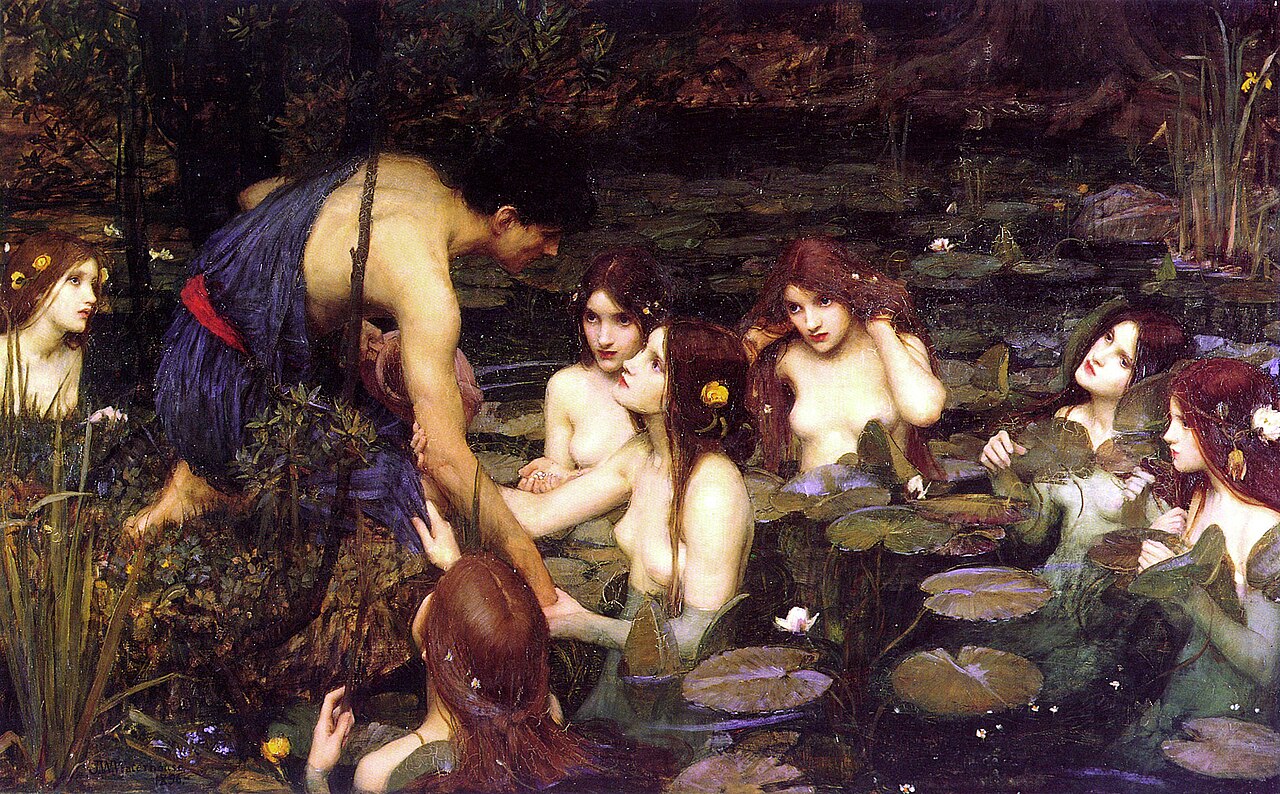
24a   Water nymphs // in a sad novel (6)

In classical mythology, a naiad[5] is a water nymph* said to inhabit a river, spring, or waterfall.

* A nymph[5] is a mythological spirit of nature imagined as a beautiful maiden inhabiting rivers, woods, or other locations.

Behind the Picture
Hylas and the Nymphs (1896)
Miffypops illustrates his review with a detail from Hylas and the Nymphs, a work by English painter John William Waterhouse[7] (1849–1917). His artworks were known for their depictions of women from both ancient Greek mythology and Arthurian legend.

In classical mythology, Hylas was a youth who served as Heracles'* companion and servant. His abduction by water nymphs was a theme of ancient art, and has been an enduring subject for Western art in the classical tradition.

* Hercules to the Romans

25a   Goes through // customs at university (4,2)

In Britain, up[5] means at or to a university, especially Oxford or Cambridge ⇒ they were up at Cambridge about the same time.

26a   Declined /to be/ escorted around German city (8)

Essen[5] is an industrial city in the Ruhr valley, in northwestern Germany.

Down

2d   /You'll find/ this admiral /in/ the hold (6)

A more straightforward way of stating this double definition might be:
  • This admiral /can be found in/ the hold (6)


Horatio Nelson[5], Viscount Nelson, Duke of Bronte (1758–1805) was a British admiral. Nelson became a national hero as a result of his victories at sea in the Napoleonic Wars, especially the Battle of Trafalgar, in which he was mortally wounded.


A nelson[5] is a wrestling hold in which one arm is passed under the opponent’s arm from behind and the hand is applied to the neck (half nelson), or both arms and hands are applied (full nelson).

Behind the Picture
Miffypops illustrates his review with a photo of Nelson's Column[7], a monument in Trafalgar Square in central London built to commemorate Admiral Horatio Nelson, who died at the Battle of Trafalgar in 1805.

3d   Nothing to do at this end (5)

Here and There
Be at a loose end[5] is a British expression meaning to have nothing specific to do ⇒ why don't you stay to eat, if you're at a loose end?. The corresponding North American expression is be at loose ends.

4d   Drivers aren't slow to fall into it (5,4)

5d   Snake // dispatched, pierced by monarch softly (7)

"monarch" = R (show explanation )

In the United Kingdom and the other Commonwealth realms*:
  • Rex[5] (abbreviation R[5]) [Latin for king] denotes the reigning king, used following a name (e.g. Georgius Rex, King George — often shortened to GR) or in the titles of lawsuits (e.g. Rex v. Jones, the Crown versus Jones — often shortened to R. v. Jones).
  • Regina[5] (abbreviation R[5]) [Latin for queen] denotes the reigning queen, used following a name (e.g. Elizabetha Regina, Queen Elizabeth) or in the titles of lawsuits (e.g. Regina v. Jones, the Crown versus Jones — often shortened to R. v. Jones).

* A Commonwealth realm[7] is a sovereign state that is a member of the Commonwealth of Nations and shares the same person, currently Elizabeth II, as its head of state and reigning constitutional monarch, but retains a crown legally distinct from the other realms. There are currently sixteen Commonwealth realms, the largest being Australia, Canada, New Zealand, and the United Kingdom with the remainder being smaller Caribbean and Pacific island nations.

hide explanation

"softly" = P (show explanation )

Piano[3,5] (abbreviation p[5]), is a musical direction meaning either (as an adjective) soft or quiet or (as an adverb) softly or quietly.

hide explanation

6d   Excursion /for/ everyone within the bounds of Surrey (5)

Scratching the Surface
Surrey[5] is a county of southeastern England; county town, Kingston upon Thames.

7d   They run // up volcano with long striding gaits (9)

Mount Etna[5] is a volcano in eastern Sicily, rising to 3,323 m (10,902 ft). It is the highest and most active volcano in Europe.

8d   Italian city // girl (8)

Florence[5] is a city in west central Italy, the capital of Tuscany, on the River Arno. Florence was a leading centre of the Italian Renaissance from the 14th to the 16th century, especially under the rule of the Medici family during the 15th century.

Behind the Picture
Miffypops illustrates his review with a photo of David[7], a masterpiece of Renaissance sculpture created between 1501 and 1504 by the Italian sculptor, painter, architect and poet Michelangelo. The statue has always been located in the city of Florence. Since 1873, it has been displayed in the Accademia Gallery. A replica was placed in the Piazza della Signoria in 1910.

The second illustration is of Florrie "Flo" Capp, wife of the title character in the British comic strip Andy Capp[7]. She is named after English social reformer and founder of modern nursing, Florence Nightingale (who was born in the city of Florence in what was then the Grand Duchy of Tuscany).

13d   Idiot /shows/ no end of charm after bottomless neglect (9)

14d   Tom in suffering sent out /for/ soothing remedies (9)

15d   Sunny spots? (8)

A question mark often signals the presence of a cryptic definition.

17d   Thoroughgoing // cad and liar needing to reform (7)

18d   Feel // composer's final part is twisted (6)

George Frideric Handel[5] (1685–1759) was a German-born composer and organist, resident in England from 1712; born Georg Friedrich Händel. A prolific composer, he is chiefly remembered for his choral works, especially the oratorio Messiah (1742), and, for orchestra, his Water Music suite (circa 1717) and Music for the Royal Fireworks (1749).

20d   That man arranged to go north, /being/ excited (3,2)

Het up[5,11] is an informal expression meaning angry and agitated ⇒ her husband is all het up about something. Het is an archaic past participle of heat that survives in Scots and northern English dialect.

22d   This person's gripped by organ // sound (5)

"this person" = I (show explanation )

It is a common cryptic crossword convention for the creator of the puzzle to use terms such as (the or this) compiler, (the or this) setter, (this) author, (this) writer, or this person to refer to himself or herself. To solve such a clue, one must generally substitute a first person pronoun (I or me) for whichever of these terms has been used in the clue.

hide explanation
Key to Reference Sources: 

[1]   - The Chambers Dictionary, 11th Edition
[2]   - Search Chambers - (Chambers 21st Century Dictionary)
[3]   - TheFreeDictionary.com (American Heritage Dictionary)
[4]   - TheFreeDictionary.com (Collins English Dictionary)
[5]   - Oxford Dictionaries (Oxford Dictionary of English)
[6]   - Oxford Dictionaries (Oxford American Dictionary)
[7]   - Wikipedia
[8]   - Reverso Online Dictionary (Collins French-English Dictionary)
[9]   - Infoplease (Random House Unabridged Dictionary)
[10] - CollinsDictionary.com (Collins English Dictionary)
[11] - TheFreeDictionary.com (Random House Kernerman Webster's College Dictionary)
[12] - CollinsDictionary.com (Webster’s New World College Dictionary)
[13] - MacmillanDictionary.com (Macmillan Dictionary)
Signing off for today — Falcon

Saturday, December 23, 2017

Saturday, December 23, 2017 — Happy Holidays


Introduction

Today's puzzle from Cox & Rathvon is appropriately seasonal in nature and should not hold you up too long from getting to your last minute Christmas shopping.

I invite you to leave a comment to let us know how you fared with the puzzle.

Solution to Today's Puzzle

Falcon's Experience
┌────┬────┬────┬────┬────┬────┬────┐
███████████████████████████████████
└────┴────┴────┴────┴────┴────┴────┘
Legend:
█ - solved without assistance
█ - incorrect prior to use of puzzle solving tools
█ - solved with assistance from puzzle solving tools
█ - solved with aid of checking letters provided by puzzle solving tools
█ - solved but without fully parsing the clue
█ - yet to be solved

Legend: "*" anagram; "~" sounds like; "<" letters reversed

"( )" letters inserted; "_" letters deleted; "†" explicit in the clue

Primary indications (definitions) are marked with a solid underline in the clue; subsidiary indications (be they wordplay or other) are marked with a dashed underline in semi-all-in-one (semi-&lit.) clues. All-in-one (&lit.) clues and cryptic definitions — including whimsical and vague definitions — are marked with a dotted underline. Explicit link words and phrases are enclosed in forward slashes (/link/) and implicit links are shown as double forward slashes (//).

Across

1a   Wake up // one of Santa's reindeer with ring (4,2)

COME T|O — COMET (one of Santa's reindeer) + (with) O ([letter that looks like a] ring)

4a   Christmas tree in front of building with one's // heaps set ablaze (8)

B|ON(FIR)E|S — FIR (Christmas tree) contained in (in) {B (front [initial letter] of Building) + ONE (†) + S ('s)}

9a   Odd situation: // Nick s rear caught in chimney passage (5)

FLU(K)E — K (Nick's rear; final letter of NicK) contained in (caught in) FLUE (chimney passage)

Scratching the Surface
Saint Nick[3] (short for Saint Nicholas) is another name for Santa Claus.

10a   December speaker /is/ expert on ornaments? (9)

DEC|ORATOR — DEC (December; abbrev.) + ORATOR (speaker)

11a   A topic shifted at the end of Kwanzaa: // pudding choice (7)

TAPIOC*|A — anagram (shifted) of {A + TOPIC} + (at; next to) A (the end [final letter] of KwanzaA)

Scratching the Surface
Kwanzaa*[3,4,11] (also Kwanza) is an an African-American cultural festival observed from December 26 to January 1, celebrating family, community, and culture.

* Kwanzaa was originally a harvest festival, with the name coming from the Swahili word kwanza 'first (fruits of the harvest)'. It was respelled in English as "kwanzaa" to have seven letters corresponding to the seven traditional African virtuous principles celebrated by the holiday.

12a   What gets Santa dirty and hot, /in/ reality (5)

SOOT|H — SOOT (what gets Santa dirty) + (and) H (hot; abbrev.)

Sooth[5] is an archaic term meaning truth.

14a   Library features // quiet helpers of Santa (7)

SH|ELVES — SH ([admonition to be] quiet) + ELVES (helpers of Santa)

16a   Letter address // is read wrong by Rudolph initially (4,3)

{DEAR SI}*|R_ — anagram (wrong) of {IS READ} + (by; next to) R (Rudolph initially; initial letter of Rudolph)

17a   Noble rank // excited lad more (7)

EARLDOM* — anagram (excited) of {LAD MORE}

20a   Wood in the hearth engulfed in pine product // scent (7)

CO(LOG)NE — LOG (wood in the hearth) contained in (engulfed in) CONE (pine product)

22a   New Jersey hockey player // had a home flipped (5)

DEVIL< — reversal (flipped) of LIVED (had a home)

The New Jersey Devils[7] are a professional ice hockey team based in Newark, New Jersey. They are members of the Metropolitan Division of the Eastern Conference of the National Hockey League (NHL). The club was founded as the Kansas City Scouts in Kansas City, Missouri, in 1974. The Scouts moved to Denver, Colorado in 1976 and became the Colorado Rockies. In 1982, they moved to East Rutherford, New Jersey and took their current name.

23a   Criticizing // a holiday chore in conversation (7)

RAPPING~ — sounds like (in conversation) WRAPPING (a holiday chore)

26a   A novice, on different // number? (9)

NOVOCAINE* — anagram (different) of {A NOVICE ON}

Number is a whimsical cryptic crossword definition denoting something that numbs.

27a   Christmas stocking brings, at first, // a certain prize (5)

NO(B)EL — NOEL (Christmas) containing (stocking) B (brings, at first; initial letter of Brings)

A Nobel Prize[5] is any of six international prizes awarded annually for outstanding work in physics, chemistry, physiology or medicine, literature, economics, and the promotion of peace. The Nobel Prizes, first awarded in 1901, are decided by members of Swedish learned societies or, in the case of the peace prize, the Norwegian Parliament.

28a   Term for Christmas // you'll even put into speech (8)

{YULE|TIDE}~ — sounds like (put into speech) {YOU'LL (†
) + TIED (even)}

29a   Santa's teddy bears // sampled (6)

_TA|S|TED_ — hidden in (bears) SanTA'S TEDdy

Down

1d   Restaurant/'s/ changing face (4)

CAFE* — anagram (changing) of FACE

2d   Law enforcer // set free after very short length of time (7)

MO|UNTIE — UNTIE (set free) following (after) MO (very short length of time)

Mo[3,5] (abbreviation for moment) is an informal, chiefly British term for a short period of time ⇒ hang on a mo!.

3d   Pipsqueak // leads in the West End revue, perhaps (5)

T_W_E_R_P_ — initial letters of (leads in) The West End Revue Perhaps

The West End[10] is a part of west central London, England containing the main shopping and entertainment areas.

5d   Place for many a tree // or green vegetable (7)

OR|CHARD — OR (†) + CHARD (green vegetable)

6d   Obstruct // many trees completely (9)

FOREST|ALL — FOREST (many trees) + ALL (completely)

7d   Lab animal is keeping on // restricted fare (7)

RAT|I(ON)S — RAT (lab animal) + IS (†) containing (keeping) ON (†)

8d   Extra payments // turn to black in waves (10)

SUR(CHAR)GES — CHAR (turn to black) contained in (in) SURGES (waves)

10d   Doctor Love, by the way, // takes a fall (5)

DR|O|PS — DR (doctor; abbrev.) + O (love; nil score in tennis) + PS (by the way; abbrev. for postscript)

Scratching the Surface
Perhaps the surface reading is an allusion to American author and motivational speaker Leo Buscaglia[7] (1924–1998), also known as "Dr. Love," who was a professor in the Department of Special Education at the University of Southern California.

While teaching at USC, Buscaglia was moved by a student's suicide to contemplate human disconnectedness and the meaning of life, and began a non-credit class he called Love 1A. This became the basis for his first book, titled simply LOVE. His dynamic speaking style was discovered by the Public Broadcasting System (PBS) and his televised lectures earned great popularity in the 1980s. At one point his talks, always shown during fund raising periods, were the top earners of all PBS programs. This national exposure, coupled with the heartfelt storytelling style of his books, helped make all of his titles national Best Sellers; five were once on the New York Times Best Sellers List simultaneously.

13d   Candy canes relocated /in/ the highest position (10)

ASCENDANCY* — anagram (relocated) of CANDY CANES

15d   Crackpot cited evil // to wit (9)

VIDELICET* — anagram (crackpot) of CITED EVIL

Videlicet[3,4,11] (abbreviation viz.) is a Latin term meaning that is (to say) or namely used to introduce examples, lists, items, etc.

18d   Old show brought back // competitor snaring empty victory (7)

R(E|V)IVAL — RIVAL (competitor) containing (snaring) {E (empty (abbrev. found on fuel gauges) + V (victory; symbol made famous by Sir Winston Churchill}

A Slip of the Fingers
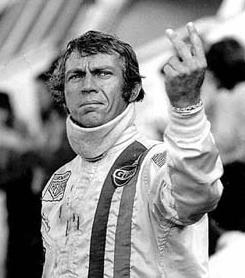
As I wrote in a recent review of a weekday cryptic crossword puzzle, one must be very careful to make the "V" sign correctly lest one cause serious offence (show explanation ).

A V sign[7] made with the fingers and with the palm facing out may be a victory sign (as made famous by Sir Winston Churchill) or a peace sign (arising from the 1960s counterculture movement). However, in Australia, New Zealand, South Africa, Ireland, and the United Kingdom, when made with the palm facing in, it means "F**k off"*.

* The Brits would seem to need two fingers to get across an idea that North Americans manage to convey with a single finger.

For a time in the UK, "a Harvey (Smith)" became a way of describing the insulting version of the V sign, much as "the word of Cambronne" is used in France, or "the Trudeau salute" is used to describe the one-fingered salute in Canada. This happened because, in 1971, show-jumper Harvey Smith was disqualified for making a televised V sign to the judges after winning the British Show Jumping Derby at Hickstead. (His win was reinstated two days later.)

Harvey Smith pleaded that he was using a Victory sign, a defence also used by other figures in the public eye. Sometimes foreigners visiting the countries mentioned above use the "two-fingered salute" without knowing it is offensive to the natives, for example when ordering two beers in a noisy pub, or in the case of United States president George H. W. Bush, who, while touring Australia in 1992, attempted to give a "peace sign" to a group of farmers in Canberra—who were protesting about U.S. farm subsidies—and instead gave the insulting V sign.

Steve McQueen in Le Mans
Steve McQueen gives a British (knuckles outward) V sign in the closing scene in the 1971 motorsport movie 'Le Mans'. A still picture of the gesture was also recorded by photographer Nigel Snowdon and has become an iconic image of both McQueen and the 24 hours of Le Mans.


hide explanation

19d   Confused admirer // got hitched (7)

MARRIED* — anagram (confused) of ADMIRER

Depending on the context, the definition could be either "hitched" ⇒ She got married (hitched) to her childhood sweetheart or "got hitched" ⇒ She married (got hitched) at the age of twenty-one.

If the definition were to be taken as merely "hitched", then the word "got" would need to be considered a link word between the wordplay and definition:
  • Confused admirer /got/ hitched (7)
20d   Police heard /in/ thicket (5)

COPSE~ — sounds like (heard) COPS (police)

21d   Information unit/'s/ job, somewhat (7)

GIG|A|BIT — GIG (job [for a member of a musical group]) + {A BIT (somewhat)}

24d   Old Greek land // in region I approached (5)

_ION|I|A_ — hidden in (in) regION I Approached

In classical times, Ionia[5] was the central part of the west coast of Asia Minor, which had long been inhabited by Hellenic people (the Ionians) and was again colonized by Greeks from the mainland from about the 8th century BC.

25d   Guided behind the front of Santa/'s/ vehicle in the snow (4)

S|LED — LED (guided) following (behind) S (the front [initial letter] of Santa)

Epilogue

Wishing all readers a joyous holiday season, whatever you may happen to be celebrating — whether it be Christmas, Hanukkah, Kwanzaa, or other festivity.
Key to Reference Sources: 

[1]   - The Chambers Dictionary, 11th Edition
[2]   - Search Chambers - (Chambers 21st Century Dictionary)
[3]   - TheFreeDictionary.com (American Heritage Dictionary)
[4]   - TheFreeDictionary.com (Collins English Dictionary)
[5]   - Oxford Dictionaries (Oxford Dictionary of English)
[6]   - Oxford Dictionaries (Oxford American Dictionary)
[7]   - Wikipedia
[8]   - Reverso Online Dictionary (Collins French-English Dictionary)
[9]   - Infoplease (Random House Unabridged Dictionary)
[10] - CollinsDictionary.com (Collins English Dictionary)
[11] - TheFreeDictionary.com (Random House Kernerman Webster's College Dictionary)
[12] - CollinsDictionary.com (Webster’s New World College Dictionary)
[13] - MacmillanDictionary.com (Macmillan Dictionary)
Signing off for today — Falcon

Friday, December 22, 2017

Friday, December 22, 2017 — DT 28534

Puzzle at a Glance
Puzzle Number in The Daily Telegraph
DT 28534
Publication Date in The Daily Telegraph
Saturday, September 16, 2017
Setter
Unknown
Link to Full Review
Big Dave's Crossword Blog [DT 28534 – Hints]
Big Dave's Crossword Blog [DT 28534 – Review]
Big Dave's Crossword Blog Review Written By
Big Dave (Hints)
crypticsue (Review)
BD Rating
Difficulty - ★ Enjoyment - ★★★
Falcon's Experience
┌────┬────┬────┬────┬────┬────┬────┐
███████████████████████████████████
└────┴────┴────┴────┴────┴────┴────┘
Legend:
█ - solved without assistance
█ - incorrect prior to use of puzzle solving tools
█ - solved with assistance from puzzle solving tools
█ - solved with aid of checking letters provided by puzzle solving tools
█ - solved but without fully parsing the clue
█ - unsolved or incorrect prior to visiting Big Dave's Crossword Blog
█ - solved with aid of checking letters provided by solutions from Big Dave's Crossword Blog
█ - reviewed by Falcon for Big Dave's Crossword Blog
█ - yet to be solved
Notes
As this was a Saturday "Prize Puzzle" in Britain, there are two entries related to it on Big Dave's Crossword Blog — the first, posted on the date of publication, contains hints for selected clues while the second is a full review issued following the entry deadline for the contest. The vast majority of reader comments will generally be found attached to the "hints" posting with a minimal number — if any — accompanying the full review.

Introduction

This is a nice easy puzzle to ease us into the holiday weekend. I might not rate it as low as the one star for difficulty awarded it by crypticsue but it certainly did not overtax me.

I do apologize for posting reviews for the wrong puzzles earlier in the week. It being an extremely busy week for me, I had prepared the reviews in advance. When I do this, I usually check on the day of publication to verify that the expected puzzle has actually appeared. It seems that after many months during which the National Post did not skip a puzzle, I was lulled into a false sense of security and neglected to check this time. The ever vigilant editors at the National Post — who are nothing if not patient — seized the opening to toss a couple of puzzles onto the cutting room floor.

I have now posted the correct review for the puzzle published on Tuesday. For the Wednesday and Thursday puzzles, I am afraid you will have to make do with the reviews on Big Dave's Crossword Blog to which I have posted links.

The fact that the National Post had dumped some puzzles may have slipped by me undetected but at least I recognized today's puzzle as a pangram — a puzzle in which every letter of the alphabet appears at least once in the solutions to the clues.

I invite you to leave a comment to let us know how you fared with today's puzzle.

Notes on Today's Puzzle

This commentary is intended to serve as a supplement to the review of this puzzle found at Big Dave's Crossword Blog, to which a link is provided in the table above.

Primary indications (definitions) are marked with a solid underline in the clue; subsidiary indications (be they wordplay or other) are marked with a dashed underline in semi-all-in-one (semi-&lit.) clues. All-in-one (&lit.) clues and cryptic definitions are marked with a dotted underline. Explicit link words and phrases are enclosed in forward slashes (/link/) and implicit links are shown as double forward slashes (//).

Across

8a   'Stormy Weather' overwhelms a // songster (8)

Northern wheatear (male)
The wheatear[5] is a mainly Eurasian and African songbird related to the chats, with black and buff or black and white plumage and a white rump. There are several species, in particular the grey-backed (northern) wheatear (Oenanthe oenanthe) of Eurasia and northeastern Canada.

Delving Deeper
The wheatears[7] are passerine birds of the genus Oenanthe. They were formerly considered to be members of the thrush family, Turdidae, but are now more commonly placed in the flycatcher family, Muscicapidae. This is an Old World group, but the northern wheatear has established a foothold in eastern Canada and Greenland and in western Canada and Alaska.

The name "wheatear" is not derived from "wheat" or any sense of "ear", but is a folk etymology of "white" and "arse", referring to the prominent white rump found in most species.

The genus name Oenanthe is derived from the Greek oenos (οίνος) "wine" and anthos (ανθός) "flower". It refers to the northern wheatear's return to Greece in the spring just as the grapevines blossom.

Scratching the Surface
"Stormy Weather"[7] is a 1933 torch song written by Harold Arlen and Ted Koehler. Ethel Waters first sang it at The Cotton Club night club in Harlem in 1933 and recorded it that year. Although I prefer the Billie Holiday version, here is the original.


9a   Forge // commonplace name as front for unknown quantity (6)

"unknown quantity" =  Y (show explanation )

In mathematics (algebra, in particular), an unknown[10] is a variable, or the quantity it represents, the value of which is to be discovered by solving an equation ⇒ 3y = 4x + 5 is an equation in two unknowns. [Unknowns are customarily represented symbolically by the letters x, y and z.]

hide explanation


A smithy[3] (also called smithery) is a blacksmith's shop or forge.

10a   Agent keeps Rex // nimble (4)

"Rex" = R (show explanation )

In the United Kingdom and the other Commonwealth realms*, Rex[5] (abbreviation R[5]) [Latin for king] denotes the reigning king, used following a name (e.g. Georgius Rex, King George — often shortened to GR) or in the titles of lawsuits (e.g. Rex v. Jones, the Crown versus Jones — often shortened to R. v. Jones).

* A Commonwealth realm[7] is a sovereign state that is a member of the Commonwealth of Nations and shares the same person, currently Elizabeth II, as its head of state and reigning constitutional monarch, but retains a crown legally distinct from the other realms. There are currently sixteen Commonwealth realms, the largest being Australia, Canada, New Zealand, and the United Kingdom with the remainder being smaller Caribbean and Pacific island nations.

hide explanation

11a   Recover consciousness -- and die /as/ result? (4,2,4)

12a   Two separate points in landing-place /could make you/ groggy (6)

The link phrase "could make you" can be interpreted as 'could produce (make) [for] the solver (you)'.


In her review, crypticsue questions whether "groggy and queasy mean the same thing". You be the judge:
  • Groggy[5] means dazed, weak, or unsteady, especially from illness, intoxication, sleep, or a blow ⇒ the sleeping pills had left her feeling groggy.
  • Queasy[5] means nauseous or feeling sick ⇒ in the morning he was still pale and queasy.
I'm thinking that I'm feeling grogginess in my head and queasiness in my gut.

14a   Passing over // treeless area (8)

... like an aircraft, as it takes off, passing over an obstacle at the end of a runway.

15a   Make a takeover bid in the air (7)

This is not a financial transaction — at least not as one would normally envision such.

17a   Trace // undergarment -- one, say, that has been returned (7)

Here and There
In Britain, a vest[5] is an undergarment worn on the upper part of the body, typically having no sleeves. The garment that North Americans (as well as Australians) call a vest is known in the UK as a waistcoat.

20a   Stick // bond with glue coming unstuck (8)

A bludgeon[5] (noun) is a thick stick with a heavy end, used as a weapon ⇒ maces and spiked bludgeons.

22a   Article by church dignitary // of South American eminence (6)

Note that the word "of" is included in the definition, making the solution an adjective.

A dean[7], in a religious context, is a cleric holding certain positions of authority within a religious hierarchy. The title is used mainly in the Anglican Communion, the Roman Catholic Church, and the Lutheran Church.

In the Church of England and elsewhere in the Anglican Communion, the dean is the chief resident cleric of a cathedral or other collegiate church and the head of the chapter of canons. If the cathedral or collegiate church has its own parish, the dean is usually also rector of the parish.


Eminence[5] is a formal or literary term denoting a piece of rising ground ⇒ an eminence commanding the River Emme.

The Andes[5] are a major mountain system running the length of the Pacific coast of South America. Its highest peak is Aconcagua, which rises to a height of 6,960 m (22,834 ft).

23a   Announced // more placid rambling (10)

24a   Founder // of football body I left (4)

The Football Association[7], also known simply as the FA, is the governing body of football [soccer] in England. Formed in 1863, it is the oldest football association in the world and is responsible for overseeing all aspects of the amateur and professional game in England.


Founder[5] denotes (of a plan or undertaking) to fail or break down as a result of a particular problem ⇒ the talks foundered on the issue of reform.

25a   Joins together // tunes I composed (6)

26a   Patent a clever gripping // thing to wave about (8)

Down

1d   Rodent // bit sandwiches I'm holding quietly (8)

"quietly" = P (show explanation )

Piano[3,5] (abbreviation p[5]), is a musical direction meaning either (as an adjective) soft or quiet or (as an adverb) softly or quietly.

hide explanation

2d   Last character coming in to cut grass /is/ dim (4)

3d   Catch sight of // Swedes crying, seeing display of centre half! (6)

Descry[5] is a literary term meaning to catch sight of ⇒ she descried two figures.

4d   Unpleasant expert /gives/ scowl (7)

5d   Weariest after running around, // in a way (2,2,4)

As it were[5] is a phrase meaning in a way (used to be less precise) ⇒ areas which have been, as it were, pushed aside.

6d   Stopped swallowing whisky, perhaps // dejected (10)

7d   So uplifting, tucking into cold chicken // selected (6)

13d   Notice little Judith in hearing, little Catherine /being/ judge (10)

Cate[7] is a feminine given name. It is a variant of Kate and a diminutive of Catherine. The name comes from Latin, French, English, and Welsh origins. The name literally means either 'pure' or 'blessed'. Perhaps the best known bearer of the name is Australian actress Cate Blanchett[7].

Was it necessary to say that?
The setter needn't have resorted to the use of a homophone in the clue. Judi in its own right is a diminutive of Judith, witness English actress Dame Judi Dench[7].

16d   Crack up in the mountains (8)

18d   I dig all wild hedging round // flowers (8)

The gladiolus[5] (plural gladioli) is an Old World plant of the iris family, with sword-shaped leaves and spikes of brightly coloured flowers, popular in gardens and as a cut flower.

19d   Enliven // an Ulster companion (7)

Properly Ulster[10] is an area that was a province and former kingdom of northern Ireland which passed to the English Crown in 1461. Following centuries of conflict, Ulster was partitioned in 1921, with six counties [Antrim, Down, Armagh, Londonderry, Tyrone, and Fermanagh] forming Northern Ireland (a region within the United Kingdom) and three counties [Cavan, Donegal, and Monaghan] joining the Republic of Ireland. Despite this, Ulster is a widely-used (albeit inaccurate) name for Northern Ireland.

"Northern Ireland" = NI (show explanation )

Northern Ireland[5] (abbreviation NI[5]) is a province of the United Kingdom occupying the northeast part of Ireland; population 1,775,000 (est. 2008); capital, Belfast.

According to Oxford Dictionaries, Northern Ireland[5] is the only major division of the United Kingdom to hold the status of province, with England[5], Scotland[5] and Wales*[5] being countries.

* Oxford Dictionaries did not always describe Wales as a country. However, they changed this after I pointed out in a previous blog that England and Scotland were described as countries while Wales was shown as a principality. Do I really have such power?

hide explanation

In Britain, mate[5] — in addition to being a person’s husband, wife, or other sexual partner — is an informal term for a friend or companion ⇒ my best mate Steve.

According to Hoyle
Well, maybe not Hoyle but Webster perhaps.

The indefinite article must accord with the noun that it modifies. Thus "an Ulster" in the clue becomes "a N(orthern) I(reland)" in the solution.

21d   Animal seizing artist round // throat (6)

"artist" = RA (show explanation )

A Royal Academician (abbreviation RA[10]) is a member of the Royal Academy of Arts[5] (also Royal Academy; abbreviation also RA[10]), an institution established in London in 1768, whose purpose is to cultivate painting, sculpture, and architecture in Britain. 

hide explanation

22d   Burning // some garden trash (6)

24d   Loud friend turns up -- // panic! (4)

"loud" = F (show explanation )

Forte[5] (abbreviation f[5]) is a musical direction meaning (as an adjective) loud or (as an adverb) loudly.

hide explanation
Key to Reference Sources: 

[1]   - The Chambers Dictionary, 11th Edition
[2]   - Search Chambers - (Chambers 21st Century Dictionary)
[3]   - TheFreeDictionary.com (American Heritage Dictionary)
[4]   - TheFreeDictionary.com (Collins English Dictionary)
[5]   - Oxford Dictionaries (Oxford Dictionary of English)
[6]   - Oxford Dictionaries (Oxford American Dictionary)
[7]   - Wikipedia
[8]   - Reverso Online Dictionary (Collins French-English Dictionary)
[9]   - Infoplease (Random House Unabridged Dictionary)
[10] - CollinsDictionary.com (Collins English Dictionary)
[11] - TheFreeDictionary.com (Random House Kernerman Webster's College Dictionary)
[12] - CollinsDictionary.com (Webster’s New World College Dictionary)
[13] - MacmillanDictionary.com (Macmillan Dictionary)
Signing off for today — Falcon